Israr Jan-Parker was diagnosed with a Petroclival Meningioma in June 2022 after going to the hospital with chronic pain that had started travelling down her leg. She never expected to be told she had a brain tumour.
For around a year, Israr had lived with bad chronic pain.
At first, it seemed like a back problem. The pain began travelling down her leg, and she tried different routes to find answers. She saw chiropractors and osteopaths, tried lotions and remedies, and kept looking for something that would explain why her body was not working as it should.
But nothing fixed the pain.
Then her left leg started to become affected.
“It got to a stage where I was literally dragging my left leg.”
For Israr, who had always seen herself as fit, active and independent, this was frightening. She loved the outdoors and exercise. She also came from a visual background in film and fashion, so she felt very self-conscious of the way she was moving.
“I think I did have a hunch that there was something wrong.”
Eventually, Israr decided to go private. The consultant arranged a full spinal scan, but also included a head scan.
That decision changed everything.
An Incidental Finding
Israr’s brain tumour was found incidentally.
She had gone into hospital because of chronic pain and problems with her leg, not because she expected anyone to find a tumour in her brain.
The scan showed that she had a Petroclival Meningioma.
“It’s quite an unusual meningioma.”
Israr explains that the tumour sat close to the centre of the skull, near many important structures. These included the brainstem, cranial nerves and important blood vessels.
This helped explain why so many things had started going wrong in her body.
Her tumour had likely been growing for around 15 years without being detected.
After losing her mum in late 2021, Israr believes the trauma and stress affected her health, and her tumour began causing more obvious problems. As it grew and pressed on critical structures, it started affecting her leg and other parts of her body.
Listen to Israr tell her story in full in the Aunty M Brain Tumours Talk Show interview below, or keep reading for the written version
Surgery Was Moved Forward
Israr’s surgery was originally planned for November 2022.
But her surgeon moved the operation forward.
That decision was vital.
Israr was told that if she had waited until the original November date, she could have lost all function in her legs, even after surgery. Once nerves are permanently damaged, they cannot always recover.
“I am so lucky because they did find it.”
A 16-Hour Operation
Israr’s operation lasted around 16 hours.
Claire, who also had a long brain tumour operation herself, described how huge that length of surgery is — to be on the operating table for that amount of time, with surgeons working around such delicate and important structures.
For Israr, waking up afterwards was confusing and frightening.
“I thought, am I in hell or in heaven?”
She could hear sounds, but her brain felt “mushy.” She could not move. She had lost function in her legs, could not swallow, and had tubes coming out of her body.
But she had survived.
“The good news is I survived the operation.”
Because of the tumour’s position near the brainstem, cranial nerves and important blood vessels, not all of the tumour could be safely removed. Israr still has some tumour left and continues to be monitored with MRI scans.
At first, she was scanned every three months. Now, because her team feels the remaining tumour is stable, she is moving to annual scans.
“I feel confident about that.”
Learning to Walk, Eat and Balance Again
Recovery has meant relearning basic things.
Israr has had to learn to walk again, eat again and balance herself.
“I had no balance.”
She has come a long way, but there are still things she is waiting and hoping will improve.
One of the biggest ongoing effects is her vision.
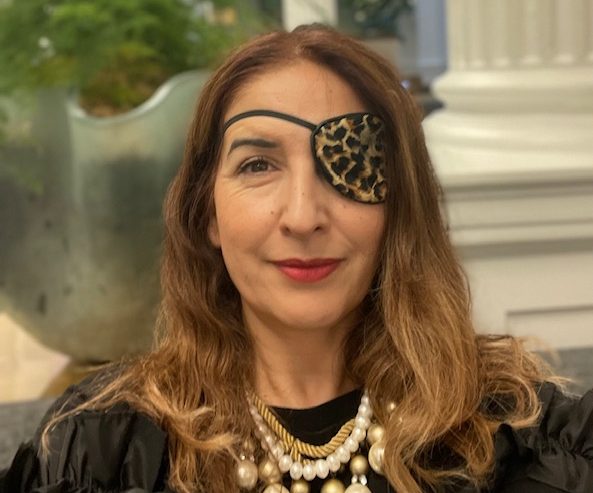
Israr wears an eye patch because she has double and triple vision. At first, one eye was completely shut. Gradually, the eyelid began to open, although it still does not open fully.
The affected eyeball also did not move at first. Now it can move from side to side, but not up and down.
There is no guarantee that the nerves will fully recover.
“For me, it’s a visual impairment because I see double.”
Israr also has problems with depth perception. When walking downstairs, she does not always see steps clearly.
“I don’t see stairs, I just see flat.”
This means she has to be especially careful, particularly in places where steps are not clearly marked.
Noise, Crowds and Sensory Overload
Alongside the physical symptoms, Israr also experiences noise and sensory difficulties.
She describes having noises in her head, including whooshing or vibration-like sounds. Crowded spaces can become overwhelming. Sounds can merge together into one big noise.
“When I’m in a busy environment, my brain is trying to make sense of all the new sensories and process it.”
This makes everyday life harder than people may realise.
On the outside, people may see the eye patch and know something has happened. But they may not understand the balance problems, visual difficulties, hearing difficulties, fatigue and processing effort that still affect her.
Israr explains it in a way that many brain tumour survivors will understand:
“You are a motorway and I’m a back road.”
Other people can get from one place to another quickly, like travelling on a motorway. Israr can still get there, but it takes longer. Her route is slower, more scenic, and sometimes there are obstacles along the way.
“Eventually I do get there, but sometimes it’s frustrating.”
Returning to Work
Israr works as a lecturer in fashion management with marketing at the University of Chichester.
Her work involves staying up to date with fashion companies, marketing, business strategies and industry changes.
Returning to work has been a big step.
Her surgeon had not officially said she should go back yet, and some people felt it might still be early. But Israr wanted to start.
“If I don’t go now, I’ll be waiting forever.”
Her employer has been supportive and planned a very slow phased return. She started with mornings only and will gradually increase her hours.
For Israr, returning to work is not only about stamina. It is also about memory and familiarity.
On her first day back, she found it upsetting that she did not recognise some buildings or her room.
“I wasn’t expecting that.”
When she returns to familiar places, the memory often comes back after a while. But it is still challenging.
She is also relearning her teaching material.
“I’m relearning absolutely everything.”
The Eye Patch and Confidence
At first, Israr felt very self-conscious about her eye, especially when it was completely shut.
She started wearing eye patches and has since received compliments on them.
More importantly, the eye patch has become part of how she manages her visual impairment and moves through the world.
“I am so grateful to be alive.”
She recognises that one eye is not working properly, but she also holds onto the fact that she is not completely blind.
This gratitude does not take away the difficulty, but it helps her keep perspective.
Finding Support After Feeling Forgotten
When Israr came home after surgery, there were communication problems between the hospital and her GP.
She says she received no support at all.
“We didn’t know what to expect. Nobody called us to say, ‘How are you doing?’”
Israr and her family had to research many therapies themselves, and some had to be paid for privately.
The first charity she managed to reach was Brain Tumour Research. They signposted her to Brainstrust, and that made a real difference.
“The minute I got in touch with them, I was really grateful.”
That experience made Israr want to help too.
Fundraising for Brain Tumour Research
After everything Israr had been through, she wanted to do something to help others.
She has taken part in charity walks for Brain Tumour Research and has been training for a 106km challenge.
She started by walking for around 15 minutes. Over time, she built that up to two or three hours, with her longest walk reaching 14 miles.
The 106km challenge is the equivalent of around two marathons, so Israr is building her distance, stamina and strength gradually.
“I’ll just keep increasing each week — the distance, but also my stamina.”
She is also using weights, working on her back strength, eating better and becoming more aware of what she puts into her body.
Donate to Israr’s JustGiving page: HERE
Oxygen Therapy
Israr has also tried oxygen therapy.
She is claustrophobic, so she finds it difficult, but she believes it may have helped accelerate some of her nerve growth.
Her surgeon has told her she is ahead of where he expected her to be.
The difficult part is that oxygen therapy is not available on the NHS, so access can be limited.
“You Look Great” — But Not Feeling Great Inside
One of the hardest parts of recovery for Israr was the difference between how she looked on the outside and how she felt on the inside.
People would tell her:
“You look great. You’re doing so well.”
But Israr did not feel great.
She tried to appear as normal as possible because she did not want her husband, her boys, family or friends to worry about her. Like many brain tumour patients, she put on a brave face.
“You put on a brave face, don’t you?”
Through Macmillan and Bupa, Israr found out about six counselling sessions. She was signposted to a counsellor who had also experienced a brain tumour, and that made a big difference.
He helped her understand that although physical recovery can be visible — walking, moving, getting stronger — the emotional impact can be hidden.
“On the outside, your physical things like walking come back to you. But on the inside, you’re broken.”
Counselling helped Israr understand that it was okay to feel vulnerable. It was okay for other people to see that. And it was okay to ask for help.
She now believes counselling should be offered and explained to brain tumour patients before surgery, not only afterwards. She also feels support should be available for families, because they go through trauma too.
Why Talking Matters
At first, Israr did not want to talk about herself.
She also worried that people might become bored of hearing about her brain tumour story.
But she now sees how important it is to talk.
“This is why I agreed to talk more about my experience.”
She wants people to know that they can come out the other side.
It is not all doom and gloom.
Recovery is not always fast. It is not always simple. But tiny steps matter.
“As long as you’re moving in a forward direction, those tiny steps will mount.”
The Beyond Recovery Project
Israr also wanted to mention Sue from the Beyond Recovery Project.
Meeting someone else who had experienced a brain tumour operation felt like another milestone for her.
She did not have to explain every symptom. The fatigue, nausea, balance problems, perception changes and noises in her head were understood.
That kind of understanding is powerful.
The Beyond Recovery Project helps brain tumour survivors through challenges and experiences that build confidence and create a sense of achievement.
For Israr, organisations like this can help people rebuild not only their bodies, but also their belief in what is possible.
About Israr’s Tumour: Petroclival Meningioma
Israr was diagnosed with a Petroclival Meningioma.
A meningioma is a tumour that starts in the meninges, which are the protective layers around the brain and spinal cord.
A clival meningioma is a type of skull base meningioma. The clivus is an area deep at the base of the skull, close to important structures such as the brainstem, cranial nerves and major blood vessels.
Because of this location, clival meningiomas can be complex.
Symptoms may happen because the tumour presses on nearby nerves or structures. Depending on the individual, this can affect balance, swallowing, walking, hearing, vision, facial movement, eye movement and other neurological functions.
Israr experienced:
- Chronic pain
- Pain travelling down her leg
- Dragging her left leg
- Loss of leg function after surgery
- Difficulty swallowing after surgery
- Balance problems
- Double and triple vision
- Reduced eye movement
- Depth perception difficulties
- Noises in her head
- Sensory overload in busy places
- Fatigue and processing difficulties
Treatment for meningioma depends on the tumour’s size, location, symptoms, growth and grade. Some meningiomas can be monitored with regular scans. Others may need surgery, radiotherapy or a combination of treatments.
In Israr’s case, surgery was needed because the tumour was affecting critical structures. Some tumour remains, so she continues to be monitored with MRI scans.
Support for People With Clival Meningioma or Skull Base Meningioma
A clival meningioma can affect far more than one part of the body. Because it is close to the brainstem and cranial nerves, recovery may involve many areas of life, including movement, vision, balance, hearing, swallowing, fatigue, confidence and emotional wellbeing.
Support can make a huge difference.
Brainstrust
Brainstrust offers personalised support for people with meningioma and other brain tumours. Their support can help people understand what matters to them after diagnosis and live as well as possible.
Brain Tumour Research
Brain Tumour Research funds research, raises awareness and campaigns for better outcomes for people affected by brain tumours. Israr contacted Brain Tumour Research and was signposted onwards to further support.
The Brain Tumour Charity
The Brain Tumour Charity provides information about meningioma symptoms, diagnosis, treatment and living with a brain tumour. They also offer support services for patients, families and carers.
Macmillan Cancer Support
Macmillan can provide emotional, practical and financial support. Israr found counselling support through Macmillan and Bupa, which helped her process the emotional impact of what had happened.
Headway
Headway supports people affected by brain injury. For those dealing with neurological changes after brain tumour surgery, such as fatigue, memory issues, balance problems or sensory overload, their resources may be useful.
Visual Impairment Support
Because Israr has double and triple vision, reduced eye movement and depth perception problems, support from an eye specialist, neuro-ophthalmology team, orthoptist or visual impairment service may be helpful.
Physiotherapy and Rehabilitation
Physiotherapy, occupational therapy and rehabilitation can help with walking, balance, strength, stamina and adapting daily life after brain tumour surgery.
Counselling and Emotional Support
Israr’s story shows how important counselling can be. Physical recovery and emotional recovery do not always happen at the same speed.
You may look well before you feel well.
Counselling can help patients and families process trauma, grief, fear, vulnerability and the changes that come after diagnosis and surgery.
Israr’s Message
Israr’s story is about a tumour that was found when she was looking for answers to pain.
It is about waking up unable to move, learning to walk again, living with visual impairment, rebuilding confidence and taking tiny steps forward.
It is also about the invisible side of recovery.
The balance problems.
The sensory overload.
The processing delay.
The emotional trauma.
The need for support after surgery.
And the quiet determination to keep going.
Israr describes herself as taking the back road while others take the motorway.
But she is still moving forward.
And every small step matters.

Claire Bullimore is an influential figure in the brain tumour community. She embarked on her brain tumour journey and was diagnosed with an intraventricular meningioma. In response to her experiences, Claire founded ‘Aunty M Brain Tumours,’ a platform dedicated to sharing brain tumour stories. Based in London, England, Claire also identifies as a blogger and speaker for Aunty M Brain Tumours, shedding light on the challenges faced by those diagnosed and amplifying their voices for better awareness and support. Through her dedication and advocacy, Claire’s efforts have been recognized by Brain Tumour Research and other organizations, spotlighting her commitment to making a positive difference for individuals impacted by brain tumours.