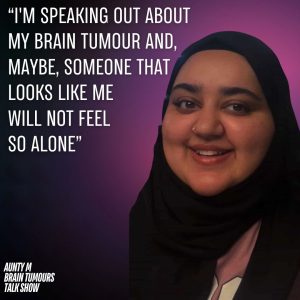
Shahleen Hussain was just 14 years old when her life changed forever
Shahleen’s Story
At just 14 years old, Shahleen Hussain’s life changed in a way she didn’t even fully understand at the time.
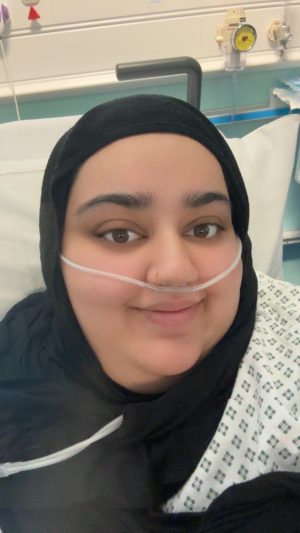
After collapsing at school in Year 7, she began experiencing worrying symptoms — nosebleeds, double vision, and seizures. But what made her journey even more difficult was that her diagnosis was kept from her.
For years, Shahleen didn’t know she had a brain tumour.
Discovering the Truth
It wasn’t until Year 11 that Shahleen discovered the truth herself.
“I was like… what? Why did nobody tell me?”
By then, her symptoms had worsened. She began experiencing stroke-like symptoms, weakness in her arms and legs, and eventually needed a wheelchair. Multiple scans confirmed what doctors had suspected — a brain tumour.
Her parents had already been told something devastating: she might only have six months to live.
Watch Shahleen tell her story in full in the Aunty M Brain Tumours Talk Show interview below, or keep reading for the written version
Living With an Inoperable Brain Tumour
Shahleen’s tumour is in a location that cannot be operated on.
Instead of surgery, her treatment involved steroid medication, which brought severe side effects:
- Rapid weight gain
- Hair loss
- Swelling in her face and body
- Vision loss in both eyes
- Weak teeth and bone issues
At school, these changes led to bullying and accusations that she was “faking it.”
At home, the impact was just as heavy. Hospital stays lasted months, her siblings missed school, and her family faced financial strain with only one income.
Epilepsy and Ongoing Health Challenges
As a result of the tumour, Shahleen developed epilepsy.
She now experiences multiple types of seizures, including:
- Absence seizures
- Myoclonic seizures
- Mixed seizure activity
Doctors are still working to find the right combination of medications.
She continues to undergo regular scans at The Christie NHS Foundation Trust, one of the UK’s leading cancer centres.
Despite periods where the tumour showed signs of growth, it has currently stabilised — but uncertainty remains.
Trauma, Fear, and Hospital Experiences
Shahleen’s early hospital experiences were difficult and, at times, traumatic.
She recalls feeling neglected during long admissions as a child — experiences that still affect her today.
Even now, every hospital visit brings fear:
“What if this is the scan where they tell me it’s growing again?”
Cultural Stigma and Silence
One of the most powerful parts of Shahleen’s story is the cultural stigma she faced.
Within parts of her community, her condition was seen as something to hide.
There is even a word used — “Nuks” — meaning “defect.”
People told her family:
- Don’t tell anyone she has a brain tumour
- Don’t talk about her seizures
- It will bring shame
- No one will want to marry her
Some even claimed her epilepsy was caused by possession or punishment.
Finding Her Voice
For a long time, Shahleen believed these messages.
She felt ashamed. She stayed silent.
But as she got older — and especially through her university studies — her perspective changed.
She began to understand:
- Epilepsy is a medical condition, not possession
- Brain tumours are not something to hide
- Cultural stigma can be harmful and dangerous
Now, she speaks openly to challenge these beliefs.
Raising Awareness in Underrepresented Communities
Shahleen noticed something important during her hospital visits:
She rarely saw anyone who looked like her.
This lack of representation made her feel isolated — and motivated her to speak out.
Today, she shares her story to:
- Encourage early diagnosis
- Challenge harmful cultural narratives
- Support others facing similar conditions
- Represent communities often left out of health conversations
Faith, Strength, and Perspective
Shahleen also draws strength from her faith.
She sees her illness not as punishment, but as a test — and even an honour.
This perspective has helped her find meaning in her journey and continue moving forward despite uncertainty.
Life Today
Now 23, Shahleen continues to live with her condition while navigating ongoing health monitoring and challenges.
Despite everything, she has achieved something she’s incredibly proud of:
She became the first person in her family to graduate from university.
Helpful Information
What is a Brain Tumour?
A brain tumour is a growth of abnormal cells in the brain. Tumours can be:
- Benign (non-cancerous)
- Malignant (cancerous)
- Low-grade (slow-growing)
- High-grade (fast-growing)
Common Symptoms
- Seizures
- Headaches
- Vision problems
- Weakness in limbs
- Balance issues
- Personality or cognitive changes
What is Epilepsy?
Epilepsy is a neurological condition that causes recurrent seizures due to abnormal electrical activity in the brain.
It is a medical condition — not caused by possession or spiritual factors.
When to Seek Help
If you or someone you know experiences:
- Unexplained seizures
- Sudden vision changes
- Persistent headaches
- Weakness or numbness
Seek medical attention as soon as possible.
Final Thoughts
Shahleen’s story is not just about living with a brain tumour.
It’s about:
- Overcoming silence
- Challenging stigma
- Finding strength in identity and faith
- Speaking up so others don’t suffer in silence
Connect With Shahleen
Search: Shahleen Hussain
She is active across social media and open to supporting others.
View this post on Instagram

Claire Bullimore is an influential figure in the brain tumour community. She embarked on her brain tumour journey and was diagnosed with an intraventricular meningioma. In response to her experiences, Claire founded ‘Aunty M Brain Tumours,’ a platform dedicated to sharing brain tumour stories. Based in London, England, Claire also identifies as a blogger and speaker for Aunty M Brain Tumours, shedding light on the challenges faced by those diagnosed and amplifying their voices for better awareness and support. Through her dedication and advocacy, Claire’s efforts have been recognized by Brain Tumour Research and other organizations, spotlighting her commitment to making a positive difference for individuals impacted by brain tumours.