From blurry vision at the gym to brain surgery, rehabilitation, and learning how to accept help
A diagnosis she tried to ignore
When Holly first noticed something was wrong, it didn’t seem dramatic enough to say out loud.
In early 2023, she had started getting blurry and double vision towards the end of her workouts. At first it only lasted a few minutes. She would sit in her car after the gym and wait for her vision to settle before driving home. Over time, it slowly got worse — so slowly that she almost adapted to it without fully realising how serious it had become.
At the time, Holly was 22 and planning to start law school later that year. She had worked hard for that future and didn’t want anything to get in the way of it.
So she ignored the symptoms.
Until one day, she Googled them.
What came up was either a problem with her glasses prescription… or a brain tumour. Holly immediately assumed it was her glasses. A brain tumour felt impossible.
“Something is wrong”
Holly booked an appointment with her eye doctor expecting a simple explanation.
Instead, he examined the backs of her eyes and saw that her optic nerve was no longer clearly visible. Comparing the new images with ones taken a year earlier, he knew something had changed significantly. He explained that it could be idiopathic intracranial hypertension, but that they first needed to rule out more serious causes — including a brain tumour.
That led to an urgent MRI.
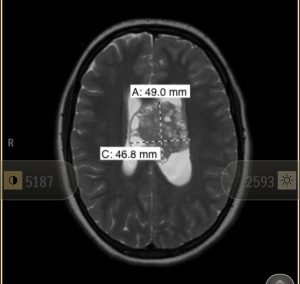
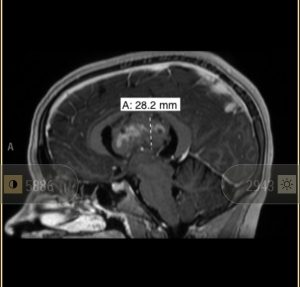
On 10 April 2023, Holly went to the hospital for the scan. Later that afternoon, she received a notification that the results were ready to view. Alone at home, she opened the report and tried to make sense of the medical language. Then she saw the words central neurocytoma.
And she saw the scan.
There was a large tumour in her ventricles.
“I think I have a brain tumour.”
Within minutes, Holly’s world had changed.
The ten-minute drive that felt endless
After calling her boyfriend into the room and trying to process what she had just read, Holly phoned her dad, then her mum. Soon after, she and her boyfriend drove to her parents’ house.
It was only a ten-minute journey.
It felt like forever.
By the time they arrived, everyone was in shock. Holly was 22, had just graduated, was supposed to be starting law school, and now she was facing a giant brain tumour diagnosis.
She didn’t want to tell everyone immediately. She needed a few days to process it herself before the news spread wider. Even on the very day she found out, she still went with a friend who had just gotten engaged to try on wedding dresses — choosing not to tell her because she didn’t want to ruin her moment.
Watch Holly tell her story in full in the Aunty M Brain Tumours Talk Show interview below, or keep reading for the written version
When everything deteriorated quickly
Over the following weeks, Holly’s condition worsened dramatically.
The tumour was pressing so badly on her optic nerve that she was effectively blind. She couldn’t tolerate light, had to wear sunglasses indoors, and kept the curtains closed. Her double vision was constant. Her headache became relentless. She was vomiting from the pain and juggling multiple pain medications just to get through the day.
Surgery was originally scheduled for the end of May 2023.
But Holly deteriorated so fast that it had to be moved forward.
A “dog fight” in surgery
Holly underwent her first brain surgery on 10 May 2023.
It lasted around ten hours. During the procedure, she haemorrhaged badly. Later, her surgeon told her parents it had been a “dog fight” in her brain. He was not confident they had managed to remove everything safely. Less than 12 hours later, after a difficult night in neuro ICU, Holly was taken back for a second operation.
The second surgery went better, and most of the tumour was removed, although a small piece remained.
Holly eventually woke up — but what came next was another mountain to climb.
 |
 |
Learning how to walk and talk again
After surgery, Holly couldn’t walk properly. She also stopped talking for several days and had weakness down the right side of her body. She spent just under a month in hospital, doing three hours a day of speech therapy, physical therapy, and occupational therapy.
She had to relearn skills she had once done without thinking.
For someone who had always been highly capable, highly driven, and fiercely independent, that was devastating.
Holly had triple-majored in undergrad, earned two bachelor’s degrees in four years, and was used to functioning at a high level. Suddenly she needed people to help her walk to the bathroom, drive her places, and keep track of conversations.
“From law student to needing five people to take me to the bathroom.”
Humour helped her survive it — but the adjustment was still brutal.
The memory loss, confusion, and guilt
One of the hardest parts after surgery was her memory.
She would wake up and forget the whole day before. She repeatedly thought her boyfriend had broken up with her. At one point, she thought she was in prison because she wasn’t allowed to leave. Another time, after seeing a friend’s Facebook post about a newborn baby, she became convinced the baby was her own and demanded to know where her daughter had gone.
Her family filled the hospital room with notes reminding her of basic facts:
- Chris had not broken up with her
- she was not in prison
- her friend Joanna had moved to Florida
As difficult as the physical recovery was, the emotional aftermath was just as heavy.
Holly says she was “riddled with guilt” for a long time — guilty that her dad sold his Bronco to help with costs, guilty that her boyfriend gave up work to be with her, guilty that the people she loved were carrying so much because she was ill.
When the tumour started growing again
For about a year after surgery, Holly was trying to recover and figure out what her new normal looked like.
Then came another blow.
A scan suggested that the small remaining piece of tumour had started to grow again. After getting a second opinion at Mayo Clinic, doctors recommended proton radiation to stop further growth and reduce the chance that she would ever need another brain surgery. Holly agreed.
She travelled to Rochester, Minnesota, for six weeks of treatment, staying in an Airbnb and taking her dog Bruno with her. Family members took turns staying with her through treatment.
What proton radiation was really like
Holly describes proton radiation as strange — but much easier than she had expected.
She had a treatment mask moulded tightly to her face and bolted to the table so she couldn’t move. Each day she would lie still while the team lined everything up and waited for the beam. The actual radiation itself only lasted seconds at a time. She couldn’t feel it, only hear the faint clicking of the machine.
The hardest side effect was nausea, especially towards the end and for months afterwards.
Still, compared to the fear of needing another surgery, proton therapy felt worth it.
What Holly wants other people to know
Holly is honest about how much this experience changed her.
She talks about how hard it was to need help. How guilty she felt. How much she struggled with not being able to do what she used to do. But she also talks about what she has learned.
One of the biggest lessons is this:
Stand up for yourself.
If something feels wrong, say it. If a treatment feels wrong, say it. If you need something different, ask for it. Holly gives the example of being put on Ritalin in hospital because doctors felt she was sleeping too much. It made her feel like she was losing her mind — and she wishes she had pushed back harder, sooner.
She also encourages people to talk openly with their support system before treatment begins, because needs can change quickly. The kind of help that feels useful one week may feel overwhelming the next.
And she believes strongly in bringing comfort and joy into hard places — whether that’s your own shampoo, a favourite podcast, a dog, or a joke that makes the people around you laugh.
Lessons from Holly’s journey
Throughout Holly’s story, a few powerful messages stand out:
- Do not ignore persistent changes – even if they seem small at first
- Trust your instincts – if something feels off, it is worth checking
- Advocate for yourself – ask questions and speak up when something doesn’t feel right
- Let people help you – even when that feels uncomfortable
- Humour can be survival – laughing doesn’t mean something isn’t serious
- Small comforts matter – especially during treatment and hospital stays
A story of survival, grit, and dark humour
Holly’s story is terrifying in places, heartbreaking in others, and often unexpectedly funny.
It is a story about losing independence and slowly rebuilding it. About fear, memory loss, surgery, radiation, and guilt. But it is also about resilience, honesty, and the people who refused to let her face any of it alone.
She gives special thanks to her boyfriend Chris, her parents Stephanie and Eric, her surgeon Kevin, her friends, everyone who donated to her GoFundMe, and Bruno — the dog who, in her words, very generously allowed her to have some of the attention.
And if there is one final thing Holly wants people to remember, it is this:
Bring as much joy as you can into a terrible situation.
Because sometimes that is what gets you through.
What Is a Central Neurocytoma?
A Central Neurocytoma is a rare type of brain tumour that usually develops within the ventricles of the brain — the fluid-filled spaces deep inside the brain. It most commonly affects young adults and is often considered slow-growing, although treatment can still involve major surgery and long-term monitoring.
Because the tumour develops in a delicate area of the brain, symptoms are often caused by pressure building inside the skull or disruption to nearby neurological pathways.
Common Symptoms of Central Neurocytoma Include:
- Persistent headaches
- Blurred or double vision
- Nausea or vomiting
- Balance problems
- Memory or concentration difficulties
- Fatigue
- Seizures
- Changes in coordination
Like many rare brain tumours, symptoms can easily be mistaken for less serious conditions in the early stages.
When Should You Seek Medical Advice?
Persistent neurological symptoms should always be checked by a medical professional, especially if they are worsening over time.
Symptoms that should never be ignored include:
- Ongoing headaches
- Blurred or double vision
- Seizures
- Balance problems
- Sudden personality or memory changes
- Persistent nausea without explanation
While these symptoms do not automatically mean a brain tumour, early investigation is always important.
You Are Not Alone
A brain tumour diagnosis changes every part of life — physically, emotionally, and mentally. But sharing experiences creates connection, awareness, and support for others facing similar journeys.
By telling her story, Holly is helping raise awareness of Central Neurocytoma and the reality of living with a rare brain tumour.
If you or someone you love has been affected by a brain tumour, know that support is available and your experiences matter.

Claire Bullimore is an influential figure in the brain tumour community. She embarked on her brain tumour journey and was diagnosed with an intraventricular meningioma. In response to her experiences, Claire founded ‘Aunty M Brain Tumours,’ a platform dedicated to sharing brain tumour stories. Based in London, England, Claire also identifies as a blogger and speaker for Aunty M Brain Tumours, shedding light on the challenges faced by those diagnosed and amplifying their voices for better awareness and support. Through her dedication and advocacy, Claire’s efforts have been recognized by Brain Tumour Research and other organizations, spotlighting her commitment to making a positive difference for individuals impacted by brain tumours.