
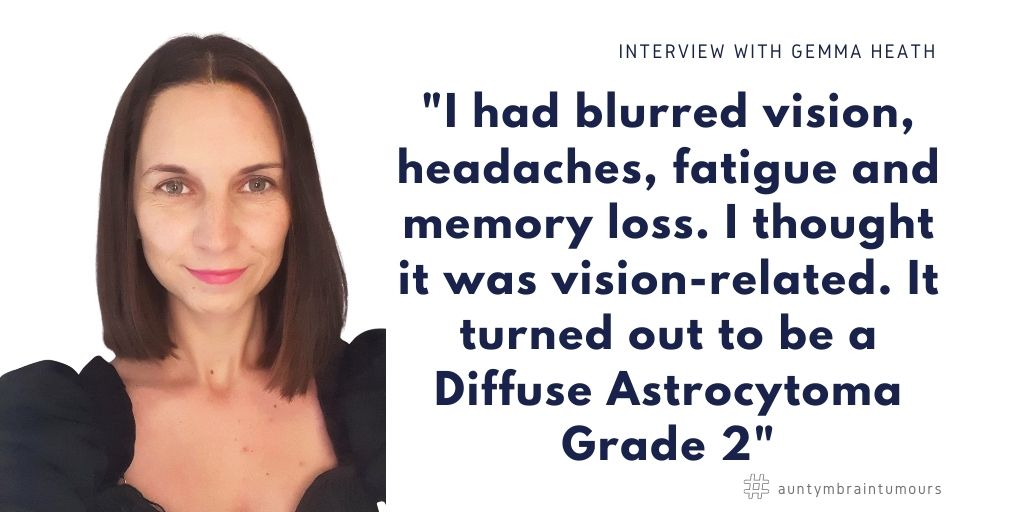
Gemma Heath had been experiencing blurred vision, headaches, fatigue and memory difficulties when she decided to visit her local optician. She thought something might be wrong with her eyesight. Instead, the examination revealed swollen optic nerves and led to the discovery of a grade 2 diffuse astrocytoma in 2018. In this personal story, Gemma shares her experience of brain surgery, living with uncertainty and why she wants people to recognise the importance of eye examinations.
The Eye Test That Changed Everything
For Gemma Heath, from Reading, a visit to the optician led to a diagnosis she never expected.
It was 2018, and Gemma had been experiencing several symptoms that were beginning to affect how she felt.
Her vision was blurred, she suffered from headaches and migraines, and she was dealing with fatigue and memory difficulties.
At first, she thought the problem might be connected to her eyesight.
She arranged an appointment with her local optician, hoping to find an explanation.
But during the examination, the optician noticed something concerning.
Gemma’s optic nerves appeared swollen.
Rather than simply recommending a change in glasses, the optician arranged an urgent appointment at the eye clinic at Royal Berkshire Hospital for the following morning.
Further investigations revealed that Gemma had a brain tumour.
She was diagnosed with a grade 2 diffuse astrocytoma.
What began as an appointment about her eyesight had unexpectedly become the start of a very different medical journey.
For Gemma, the experience would also become a reason to encourage others to attend eye examinations and seek medical advice when something doesn’t feel right.
Blurred Vision, Headaches and the First Warning Signs
Before her diagnosis, Gemma had been experiencing a combination of symptoms.
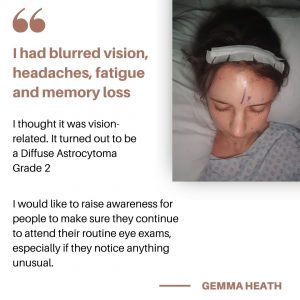
She described blurred vision, headaches or migraines, tiredness and problems with her memory.
Because her eyesight was affected, she suspected that the cause might be something an optician could identify.
The appointment proved to be an important turning point.
Her swollen optic nerves suggested that further medical investigation was needed.
Swelling of the optic discs can sometimes be associated with increased pressure inside the skull, although there are several possible causes.
The optician recognised the need for urgent assessment and arranged for Gemma to attend the hospital eye clinic.
By the following day, Gemma was receiving news that went far beyond anything she had expected from an eye examination.
A brain tumour had been found.
For someone who had gone to an optician because of blurred vision, the diagnosis was a frightening surprise.
But that appointment had helped ensure her symptoms were investigated.
Diagnosed With a Grade 2 Diffuse Astrocytoma in 2018
Gemma’s diagnosis was a grade 2 diffuse astrocytoma.
This is a type of glioma that grows within the brain’s tissue and may extend into surrounding areas.
Although grade 2 tumours are generally slower-growing than grade 3 or grade 4 tumours, they still require specialist care and monitoring.
For Gemma, the diagnosis meant preparing for brain surgery.
There was a lot to understand.
She needed information about the operation, what recovery might involve and how her life could be affected afterwards.
Her family were also facing the uncertainty that comes with a serious medical diagnosis.
Eight weeks after learning she had a brain tumour, Gemma underwent surgery.
Brain Surgery Eight Weeks After Diagnosis
Gemma underwent brain surgery approximately eight weeks after her diagnosis.
The operation was intended to remove the grade 2 diffuse astrocytoma.
Following surgery, she spent three days in hospital.
Although the operation was an important stage in her treatment, Gemma continued dealing with neurological and visual symptoms.
She was also diagnosed with intracranial hypertension, a condition involving increased pressure inside the skull.
Blurred vision remained a concern, and she underwent further investigations for some hearing difficulties.
For Gemma, leaving hospital did not mean that every medical question had been answered.
There were follow-up appointments, ongoing symptoms and the knowledge that her tumour would need continued monitoring.
But she was gradually able to return to everyday life.
Living With MRI Scans and Uncertainty
Following surgery, Gemma attended MRI scans every six months to monitor for tumour regrowth.
For many people affected by brain tumours, regular scans become a familiar part of life.
They can provide valuable information about whether a tumour has changed.
But waiting for results can also be emotionally difficult.
Gemma spoke openly about struggling with uncertainty.
She did not know what the future would hold or whether her tumour might return.
At the time of her interview, she described feeling that recurrence was a question of when rather than if.
That was Gemma’s personal fear, not a medical prediction that her tumour would inevitably return.
The likelihood and timing of recurrence vary considerably between patients and depend on the tumour’s precise characteristics, the extent of surgery and other medical factors.
Gemma was learning to live with that uncertainty while continuing to focus on her family and the things that made her happy.
Returning to Work and Finding a Way Forward
When Gemma shared her experience in February 2021, she had returned to work and was feeling well in herself.
Her headaches were under control, although she was continuing with monitoring and managing the emotional effects of her diagnosis.
She had also begun looking at life differently.
Receiving a brain tumour diagnosis had made her more aware of the importance of spending time with the people she loved.
Gemma wanted to make choices that brought happiness to herself and her family.
As she explained:
“I’ve learnt not to take anything for granted, to do what makes myself and my family happy. To live each day to its fullest.”
For Gemma, moving forward wasn’t about pretending the diagnosis had never happened.
It was about enjoying life while acknowledging that scans and uncertainty would remain part of her experience.
The Importance of Family and Being Honest With Children
Throughout her diagnosis, surgery and recovery, Gemma’s family were an enormous source of motivation.
She spoke warmly about her husband, Matthew, and their children.
Being a mum shaped how she approached the diagnosis and the conversations she had at home.
Gemma believed that being honest with her children, in a way they could understand, was important.
She also encouraged other people affected by brain tumours to be open with loved ones rather than feeling they had to manage everything alone.
A diagnosis can be frightening for family members, particularly when they do not fully understand what is happening.
For Gemma, talking together helped the family face the situation.
She also found comfort in connecting with people who had experienced brain tumours themselves.
Online support groups gave her somewhere to speak with others who understood some of the worries that can accompany diagnosis and follow-up scans.
The Medical Professionals Who Made a Difference
When I asked Gemma who her personal heroes were, she named the medical professionals who had cared for her.
Her surgeon, Mr Stacey, and neurologist, Dr Flossman, had made a lasting impression.
Dr Flossman worked at Royal Berkshire Hospital, while Mr Stacey was based at the John Radcliffe Hospital in Oxford.
Gemma credited them with providing the care she needed during an extremely difficult time.
Her experience also highlights the importance of the optician who first recognised that something required urgent investigation.
What began as a routine visit about blurred vision led to an emergency eye clinic appointment and the discovery of her tumour.
Gemma wanted people to understand that eye examinations can sometimes identify signs of health problems beyond changes in eyesight.
Finding Comfort and Helping Others
During her recovery, Gemma found that small things could help her manage anxiety.
She enjoyed reading and found relaxation helpful, particularly around the time of MRI scans.
One personal comfort was using an essential-oil diffuser with scents such as lavender or frankincense.
For Gemma, the familiar scents helped create a calming environment.
This was a personal relaxation practice rather than a medical treatment for her tumour or a proven way of preventing scan-related anxiety.
She also wanted to do something meaningful for other people affected by brain tumours.
Gemma began fundraising for The Brain Tumour Charity, taking part in a charity walk and the Conquer the Climb challenge.
Raising money and awareness gave her another way to contribute to the wider brain tumour community.
Having experienced an unexpected diagnosis herself, she wanted to help others find information, support and greater understanding.
What Gemma’s Experience Can Teach Someone Newly Diagnosed
Gemma’s story offers several useful insights for people beginning their own journey with a diffuse astrocytoma.
1. Don’t ignore unexplained changes to your eyesight.
Gemma visited an optician because of blurred vision. The examination identified swollen optic nerves that required urgent medical assessment. New or worsening vision problems deserve attention, particularly when accompanied by other neurological symptoms.
2. Give yourself time to process information.
Gemma recommends listening to the information provided by medical professionals and allowing yourself time to understand it. Writing down questions or taking someone to appointments may help.
3. Ask about your follow-up plan.
Gemma attended regular MRI scans after surgery. Your specialist team can explain why scans are recommended, how often you may need them and whom to contact if symptoms change.
4. Be honest with the people closest to you.
Gemma found open communication important, particularly when talking with her children.
5. Find people who understand.
Online support groups helped Gemma connect with others affected by brain tumours. Peer support can be valuable, although medical advice should come from qualified professionals.
6. Find ways to manage scan-related anxiety.
Waiting for scan results can be difficult. Gemma used relaxation and familiar comforting routines. If anxiety becomes overwhelming, ask your medical team about psychological support.
7. Make time for what matters to you.
For Gemma, her family, returning to work, reading and fundraising all helped her find purpose after diagnosis.
These lessons come from Gemma’s personal experience and are not a substitute for advice about an individual’s diagnosis or treatment.
Gemma’s Story: Why an Eye Examination Matters
What stands out to me about Gemma’s experience is that her journey began with an appointment she thought would simply help explain her blurred vision.
Instead, her optician noticed something unusual and arranged urgent hospital investigations.
Within weeks, Gemma was facing brain surgery for a grade 2 diffuse astrocytoma.
Although she returned to work and began feeling better, she continued living with the uncertainty of regular MRI scans.
Her experience reminds us that recovery is not always about leaving everything behind.
Sometimes it is about finding a way to enjoy life while recognising that medical follow-up and occasional anxiety may still be part of it.
Gemma’s family, her medical team and her desire to raise awareness all became important parts of her story.
For me, her message is valuable because it encourages people to pay attention to changes in their health, seek appropriate advice and make the most of the things that matter to them.
Thank you, Gemma, for sharing your experience with Aunty M Brain Tumours.
About Gemma’s Tumour: What Is a Grade 2 Diffuse Astrocytoma?
Gemma was diagnosed with a grade 2 diffuse astrocytoma in 2018.
Diffuse astrocytomas are infiltrating gliomas, meaning tumour cells can extend into surrounding brain tissue.
Grade 2 tumours generally grow more slowly than grade 3 or grade 4 tumours, but they can still cause significant symptoms and require long-term monitoring.
Since Gemma’s diagnosis, brain tumour classification has developed.
Modern diagnosis uses molecular testing, including the presence or absence of IDH mutations, to define adult diffuse gliomas more precisely.
Many tumours previously diagnosed as grade 2 diffuse astrocytoma are now classified as astrocytoma, IDH-mutant, CNS WHO grade 2. However, the historical diagnosis alone does not confirm Gemma’s molecular classification.
Anyone with an older pathology report can ask their specialist team how it relates to the current classification.
What Are the Symptoms of a Diffuse Astrocytoma?
Symptoms depend on the tumour’s location and how it affects surrounding brain tissue.
Possible symptoms include:
- Seizures
- Persistent or worsening headaches
- Memory and concentration problems
- Weakness or coordination difficulties
- Changes in speech or language
- Vision problems
- Changes in mood or behaviour
Gemma experienced headaches, blurred vision, fatigue and memory difficulties.
These symptoms can also occur for many other reasons.
However, sudden changes in vision, weakness, speech or consciousness need urgent medical assessment.
Why Might an Optician Notice a Brain-Related Problem?
During an eye examination, an optician or optometrist can sometimes identify swelling of the optic discs.
This is known as papilloedema when the swelling is caused by raised pressure inside the skull.
Raised intracranial pressure can develop for several reasons, including some brain tumours.
Not everybody with a brain tumour will have swollen optic discs, and most people who attend an eye examination will not have a brain tumour.
But Gemma’s experience shows why an optician may recommend urgent hospital assessment when an unusual finding is detected.
How Is a Grade 2 Diffuse Astrocytoma Treated?
Treatment depends on the tumour’s precise molecular classification, its location, symptoms, the extent of surgery and other individual factors.
Brain surgery: Surgeons generally aim to remove as much tumour as safely possible while protecting important brain functions.
MRI monitoring: Some patients are monitored with regular scans after surgery.
Radiotherapy and chemotherapy: These may be recommended depending on the tumour’s characteristics and risk of progression.
Targeted therapy: Certain molecularly defined grade 2 gliomas may be eligible for targeted medicines, depending on treatment history and local availability.
Rehabilitation and supportive care: Some people benefit from help with vision, cognition, seizures, fatigue or emotional wellbeing.
Gemma underwent brain surgery and described ongoing MRI monitoring in her original interview. The interview does not state that she received chemotherapy or radiotherapy.
Where to Find Support After a Diffuse Astrocytoma Diagnosis
If you or someone close to you has been diagnosed with a diffuse astrocytoma, these organisations can offer helpful information and support.
The Brain Tumour Charity
https://www.thebraintumourcharity.org/
Provides information about astrocytoma, treatment and life after a brain tumour diagnosis, along with practical and emotional support.
Brainstrust
Offers personalised support, information and help preparing for medical appointments and treatment decisions.
Brain Tumour Support
https://www.braintumoursupport.co.uk/
Provides practical and emotional support, including opportunities to connect with other people affected by brain tumours.
Astro Brain Tumour Fund
Supports people affected by low-grade gliomas and raises funds for research.
Brain Tumour Research
https://braintumourresearch.org/
Funds brain tumour research and campaigns for greater awareness and improved treatments.
For concerns about vision, headaches or neurological symptoms, contact your GP, specialist nurse or neuro-oncology team. Your team can also explain how follow-up scans and results will be managed.
Read More Diffuse Astrocytoma Stories
You may find these other experiences helpful.
Cassandra’s Diffuse Astrocytoma Story
https://auntymbraintumours.com/my-diffuse-astrocytoma-motivates-me/
Rudy’s Diffuse Astrocytoma Story
https://auntymbraintumours.com/diffuse-astrocytoma-stories/
Jaime’s IDH-Mutant Astrocytoma Story
https://auntymbraintumours.com/jaime-idh-mutant-astrocytoma-story/
Each person’s tumour and circumstances may be different, but their experiences can offer useful insight into diagnosis, treatment and living with uncertainty.
Would You Like to Share Your Brain Tumour Story?
At Aunty M Brain Tumours, I believe personal stories can help people feel understood and less alone.
Whether you have recently been diagnosed, are living with the effects of treatment or are supporting someone you love, your experience matters.
If you would like to share your brain tumour story, please get in touch through Aunty M Brain Tumours.
Gemma’s story reflects her original interview, published in February 2021, describing her diagnosis in 2018 and her circumstances at the time. Medical information is provided for general awareness and does not replace advice from a specialist healthcare professional.

Claire Bullimore is an influential figure in the brain tumour community. She embarked on her brain tumour journey and was diagnosed with an intraventricular meningioma. In response to her experiences, Claire founded ‘Aunty M Brain Tumours,’ a platform dedicated to sharing brain tumour stories. Based in London, England, Claire also identifies as a blogger and speaker for Aunty M Brain Tumours, shedding light on the challenges faced by those diagnosed and amplifying their voices for better awareness and support. Through her dedication and advocacy, Claire’s efforts have been recognized by Brain Tumour Research and other organizations, spotlighting her commitment to making a positive difference for individuals impacted by brain tumours.