Three Brain Surgeries, Recurrence and Finding Strength Through Faith
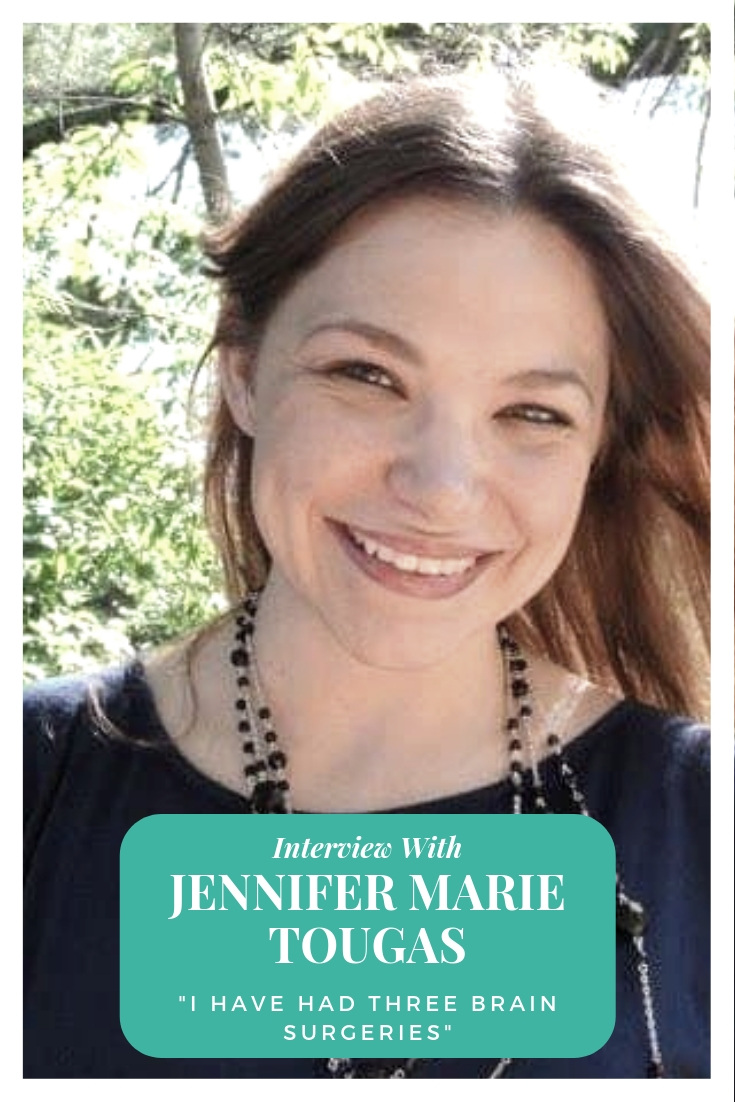
Diagnosed with a diffuse astrocytoma at just 21, Jennifer Marie Tougas went on to face further brain tumours, three brain surgeries, seizures, proton therapy and chemotherapy. Through it all, her Christian faith and love of singing helped her find strength.
For Jennifer Marie Tougas from Massachusetts, USA, discovering she had a brain tumour happened almost by accident.
In 2008, at just 21 years old, Jennifer was admitted to hospital after a fall that left her with four broken ribs and a punctured lung. During the investigations, doctors carried out a brain scan and discovered something completely unexpected.
She had a grade 2 diffuse astrocytoma.
Although Jennifer underwent successful surgery to remove the tumour, her brain tumour journey was far from over.
Nine years later, another scan revealed a new tumour, this time diagnosed as a grade 3 anaplastic astrocytoma. Within months, she faced further tumour growth, seizures and a third brain operation.
By 2021, Jennifer had undergone three brain surgeries, proton therapy and chemotherapy. She had also tried Optune, a device that uses electrical fields to interfere with cancer cell division.
Throughout these experiences, Jennifer remained determined not to let her diagnosis take away the things that mattered most to her.
Her Christian faith, music and love of singing became important sources of strength.
When Jennifer shared her story with Aunty M Brain Tumours in 2021, she spoke openly about her treatment, the challenges of living with brain cancer and why she continued to hold on to hope.
The Accident That Led to Jennifer’s Brain Tumour Diagnosis
Jennifer was just 21 when her first brain tumour was discovered in 2008.
She had been spending time with a group of people when she fell, breaking four ribs and puncturing a lung.
While she was in hospital receiving treatment for her injuries, doctors decided to carry out a CT scan and MRI scan of her brain to check for any damage to her head.
The scans revealed an unexpected abnormality.
Jennifer had a brain tumour.
Although the discovery came as a shock, looking back, she realised that she had been experiencing unusual symptoms for several years.
The Symptoms Jennifer Had Experienced Before Diagnosis
Long before the accident, Jennifer had struggled with dizziness, lightheadedness and uncomfortable pressure sensations around the right frontal area of her head.
She also experienced nausea and blurred vision.
At school, she remembered finding it difficult to see the chalkboard, particularly when the classroom lights were bright.
She was sensitive to her surroundings and experienced emotional difficulties that she found hard to understand.
Jennifer had visited doctors about some of these symptoms, but they had been attributed to other causes.
No further investigations had revealed the brain tumour.
It was only after her accident that the scans provided an explanation.
For Jennifer, discovering the tumour raised questions about how long it had been there and whether some of the difficulties she experienced growing up might have been connected.
First Brain Surgery for a Grade 2 Diffuse Astrocytoma
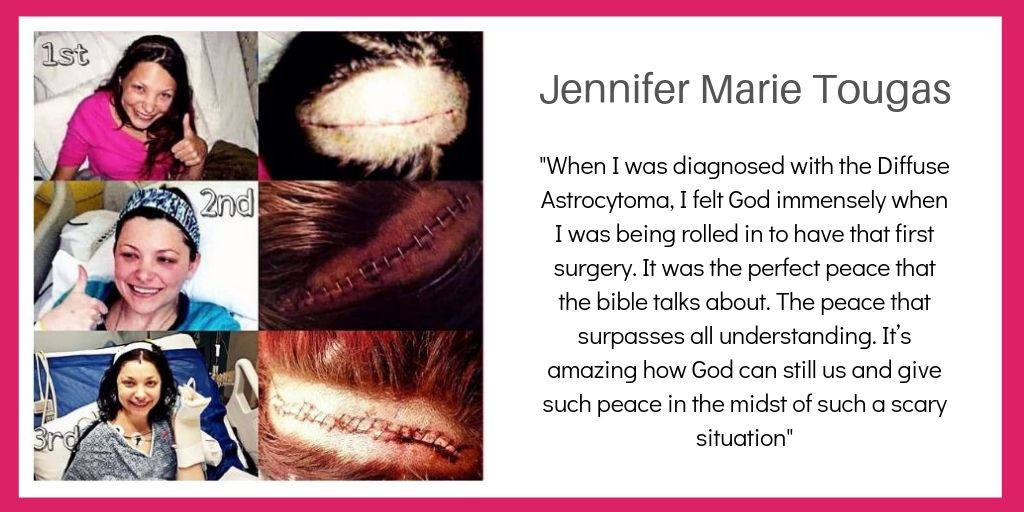
On 8 August 2008, Jennifer underwent her first brain surgery.
Her tumour was diagnosed as a grade 2 diffuse astrocytoma, a type of glioma that can grow into surrounding brain tissue.
The operation was successful, and doctors removed the tumour.
Her medical team believed it may have been growing slowly since childhood.
They also discussed whether the tumour’s location in her right frontal lobe could have contributed to some of the emotional difficulties she had experienced when she was younger.
Jennifer remembered struggling with stress, frequent crying spells and sometimes feeling disconnected from her surroundings.
The frontal lobes are involved in several important functions, including emotional regulation, decision-making and aspects of behaviour.
Although it was not possible to know whether every earlier symptom had been caused by the tumour, the diagnosis helped Jennifer reflect on experiences she had previously struggled to explain.
Recovering After Her First Brain Surgery
Following the operation, Jennifer began recovering and adjusting to life after a brain tumour diagnosis.
However, she did not feel completely well.
Over the following years, she continued experiencing symptoms that affected her everyday life.
Her MRI scans had initially been stable, and eventually she stopped attending regular scans.
Jennifer disliked the gadolinium contrast injections used during some MRI examinations, and she was also dealing with several other medical concerns.
She was undergoing investigations for genetic, autoimmune and hormonal problems, which became another focus of her healthcare.
At times, she experienced unexplained numbness and tingling in her hands, lips and feet.
She often felt unwell without understanding why.
For Jennifer, it was a frustrating period because she knew something did not feel right, but finding answers was difficult.
Nine Years Later: Another Astrocytoma Diagnosis
By 2017, Jennifer’s father had become concerned about her ongoing symptoms.
He was particularly worried that she had not had a brain MRI for some time.
His concerns prompted further investigations.
Jennifer underwent another scan, which revealed a second tumour.
This time, the diagnosis was a grade 3 anaplastic astrocytoma.
The news brought a new level of uncertainty.
Jennifer had already experienced brain surgery and years of unexplained symptoms.
Now she was facing another operation for a higher-grade tumour.
What Is the Difference Between Grade 2 and Grade 3 Astrocytoma?
Jennifer’s original tumour had been diagnosed as a grade 2 diffuse astrocytoma.
Grade 2 astrocytomas generally grow more slowly than higher-grade tumours, although they can still infiltrate surrounding brain tissue and may recur or progress over time.
Her later tumour was diagnosed as a grade 3 anaplastic astrocytoma.
Grade 3 tumours are considered high-grade and typically behave more aggressively than grade 2 tumours.
Today, molecular testing is also important in classifying astrocytomas and understanding how they may behave.
For Jennifer, the higher-grade diagnosis meant further treatment and closer attention to possible tumour growth.
Second Brain Surgery and Temporary Paralysis
On 2 March 2017, Jennifer underwent her second brain surgery.
The tumour was larger than her original astrocytoma, making the operation more complicated.
Her surgeons removed as much of it as they safely could, but complete removal was not possible.
Following the operation, Jennifer experienced temporary paralysis affecting the left side of her body.
It was another significant challenge during an already difficult period.
Brain surgery can sometimes affect movement, sensation, speech or other neurological functions, depending on the location of the tumour and the areas involved in treatment.
For Jennifer, recovering from surgery meant dealing not only with the diagnosis but also with the physical consequences of the operation.
Although the paralysis was temporary, it was an experience that added to the uncertainty surrounding her recovery.
Unfortunately, she would soon need further treatment.
Severe Seizures and a Third Brain Surgery
Just nine months after her second operation, Jennifer began experiencing frequent grand mal seizures, now commonly called tonic-clonic seizures.
These seizures can involve loss of consciousness, body stiffening and rhythmic jerking movements.
For someone living with a brain tumour, seizures can be frightening and disruptive, particularly when they become frequent or difficult to control.
Further investigations revealed that Jennifer’s tumour had grown again.
Doctors recommended another operation to remove as much tumour tissue as possible.
On 19 December 2017, Jennifer underwent her third brain surgery.
This procedure was intended to debulk the tumour, reducing its size when complete removal was not possible.
Having three brain operations within nine years, including two in 2017, was an enormous amount for Jennifer to experience.
Each operation brought its own risks, recovery period and emotional uncertainty.
But Jennifer continued to face the treatment options available to her.
Proton Therapy for Recurrent Anaplastic Astrocytoma
Following her third surgery, Jennifer’s tumour initially remained stable.
However, her medical team recommended further treatment.
In 2018, she travelled to Boston for proton therapy.
Proton therapy is a type of radiotherapy that uses proton beams to deliver radiation to a targeted area.
It may be considered for selected patients when specialists believe it offers an appropriate way of treating the tumour while limiting radiation exposure to certain surrounding tissues.
For Jennifer, the aim was to help control the remaining tumour.
After already undergoing three brain surgeries, this was another important stage of treatment.
Although proton therapy differs from conventional radiotherapy in how the radiation is delivered, it can still involve side effects and the need for ongoing monitoring.
Jennifer continued with her treatment, hoping to keep the tumour under control.
When Jennifer’s Brain Tumour Grew Again in 2020
Unfortunately, Jennifer experienced further tumour growth in 2020.
After three operations and proton therapy, she needed to consider additional options.
Her treatment included chemotherapy.
She also tried a device called Optune, which delivers tumour treating fields through adhesive arrays placed on the scalp.
The treatment uses low-intensity, alternating electrical fields designed to interfere with the division of certain cancer cells.
When Jennifer shared her story in 2021, she reported that the treatment was helping her.
Her experience reflects the uncertainty that can accompany recurrent brain tumours, particularly when several previous treatments have already been tried.
It is important to recognise that Optune has specific approved uses and is not a standard treatment for every grade 3 astrocytoma. Its use depends on the diagnosis, medical circumstances and specialist recommendations.
For Jennifer, trying another treatment represented an opportunity to continue managing her tumour.
The Emotional Challenges of Living With Recurrent Brain Cancer
Throughout her experiences, Jennifer was honest about the difficulties of living with a brain tumour.
She had endured several operations, changes in her physical health and repeated periods of uncertainty.
But the challenges were not only medical.
Jennifer found that maintaining friendships, relationships and a sense of normality could also be difficult.
The physical effects of treatment sometimes made everyday activities harder.
At other times, the emotional impact was just as challenging.
Living with brain cancer can affect someone’s confidence, independence and ability to make plans.
Even when someone appears physically well, they may be dealing with fatigue, neurological symptoms, anxiety or uncertainty about future scans.
For Jennifer, these were important parts of her experience.
She wanted people to understand that surviving a brain tumour does not automatically mean that life returns to the way it was before diagnosis.
There can be ongoing obstacles that other people do not always see.
How Jennifer’s Christian Faith Helped Her Through Brain Surgery
One of the strongest themes in Jennifer’s story is her Christian faith.
When asked what motivated her through difficult times, Jennifer explained that God was her greatest source of strength.
She particularly remembered the moments before her first brain surgery in 2008.
As she was being taken into the operating theatre, she experienced an overwhelming sense of peace.
Despite the fear and uncertainty of what was about to happen, she felt comforted by her faith.
Jennifer described it as the peace spoken about in the Bible, something she found difficult to explain but deeply meaningful.
That experience stayed with her.
As she faced further tumour diagnoses, operations and treatments, she continued to turn to her faith for reassurance.
The Bible Verses That Gave Jennifer Strength
Jennifer shared several passages from the Bible that held particular meaning for her:
Isaiah 40:29 — A reminder that God gives strength to those who are weary.
Philippians 4:13 — A passage about finding strength through Christ.
2 Corinthians 12:9 — A reminder of finding grace and strength during weakness.
For Jennifer, these verses provided comfort when her circumstances felt overwhelming.
She did not pretend that every day was easy.
There were difficult days alongside the better ones.
But her faith gave her something to hold on to, even during periods of fear and uncertainty.
Jennifer’s Love of Singing and Her American Idol Experience
One of the things I particularly love about Jennifer’s story is that there is so much more to her than her brain tumour diagnosis.
She has a passion for singing.
In fact, just one year after her first brain operation, Jennifer auditioned for American Idol in 2009.
She progressed through part of the audition process before being eliminated shortly before meeting the television judges.
It was the season eventually won by Kris Allen.
Although she did not make it onto the televised competition, the experience was something she remembered fondly.
It also showed that her brain tumour diagnosis had not taken away her enthusiasm for music.

Singing at Church and Finding a Community Through Music
Jennifer continued singing at church whenever she could.
She also discovered Smule, a karaoke-style app that allows people to record songs and sing with others.
Through the app, she could enjoy performing and connecting with people who shared her love of music.
Jennifer shared recordings of herself singing, including a song she had previously performed at church.
Music was an important part of who she was.
For someone who had spent years facing treatment and medical uncertainty, singing offered an opportunity to express herself and enjoy something outside the world of hospitals and brain scans.
It was a reminder that a diagnosis might become part of someone’s life, but it does not have to be their entire identity.
Listen to Jennifer Sing
Jennifer’s Advice for People Facing an Astrocytoma Diagnosis
Having lived with brain tumours for more than 13 years, Jennifer wanted other patients and families to know that they were not alone.
Her advice centred on holding on to hope, finding sources of strength and recognising that everyone’s experience can be different.
Hold On to Hope
Jennifer knew how frightening a brain cancer diagnosis could be, especially when conversations turned to life expectancy or prognosis.
She encouraged people not to feel that a statistical estimate could tell them exactly what would happen in their own lives.
Through her connections with other brain tumour patients, she had met people who had lived much longer than initially expected.
Their experiences helped her maintain hope.
Of course, every tumour and individual circumstance is different, and prognosis should always be discussed with the medical team.
But Jennifer wanted others to know that receiving a serious diagnosis did not mean they had to give up the things that mattered to them.
Find Something That Gives You Strength
For Jennifer, that strength came primarily from her faith.
Singing also gave her enjoyment and a way to express herself.
Other people might find similar comfort through family, friendships, hobbies, counselling or brain tumour support groups.
There is no single right way to cope with a diagnosis.
What matters is having people, activities or beliefs that provide comfort when life feels difficult.
Recognise That Recovery Is Not Always Straightforward
Jennifer’s experiences demonstrated how complicated life after brain surgery can be.
Even when scans appear stable, someone may continue dealing with symptoms or the effects of previous treatment.
Her temporary paralysis, seizures and ongoing health concerns were reminders that recovery can involve both visible and invisible challenges.
Jennifer wanted others to understand that these difficulties can affect everyday relationships, independence and emotional wellbeing.
What Is an Anaplastic Astrocytoma?
An anaplastic astrocytoma is a term historically used to describe a grade 3 astrocytic brain tumour.
Astrocytomas develop from cells associated with the brain’s supporting tissue and belong to a wider group of brain tumours known as gliomas.
Grade 3 tumours are considered high-grade because they tend to grow more rapidly and behave more aggressively than grade 2 astrocytomas.
Is Anaplastic Astrocytoma the Same as Grade 3 Astrocytoma?
The terminology used to classify brain tumours has changed over time.
Under the World Health Organization’s 2021 classification, molecular findings such as IDH mutation status are central to identifying specific types of adult diffuse glioma.
For example, a tumour previously called an IDH-mutant anaplastic astrocytoma is now generally described as astrocytoma, IDH-mutant, CNS WHO grade 3.
Other tumours previously given the anaplastic astrocytoma label may be classified differently depending on their molecular characteristics.
Because Jennifer’s earlier diagnoses were made before these changes, this article preserves the terminology she originally shared.
Her precise classification under the newer system cannot be established without her pathology results.
What Are the Symptoms of Grade 3 Astrocytoma?
Symptoms depend on the tumour’s size, location and effect on nearby brain tissue.
They may include:
- Seizures
- Persistent or worsening headaches
- Nausea or vomiting
- Changes in vision
- Weakness or altered sensation
- Problems with concentration or memory
- Personality, mood or behavioural changes
- Difficulties with speech, balance or coordination
For Jennifer, her experiences included headaches, dizziness, blurred vision, sensory changes and later significant seizures.
However, these symptoms can have many causes and do not automatically indicate a brain tumour.
New or worsening neurological symptoms should be assessed by a healthcare professional.
How Is Grade 3 Astrocytoma Treated?
Treatment depends on the tumour’s location, molecular characteristics, previous treatment and the patient’s individual circumstances.
Options may include surgery, radiotherapy, chemotherapy and ongoing MRI monitoring.
Specialists may also consider clinical trials or other treatment approaches where appropriate.
Jennifer’s experience involved several different treatments across many years.
Her story demonstrates why some patients require further treatment following recurrence, and why each treatment decision needs to be considered individually.
What Jennifer’s Astrocytoma Story Teaches Us
Jennifer’s story is about more than undergoing three brain surgeries.
It begins with a young woman who discovered she had a brain tumour almost by accident.
At 21, she underwent surgery for a grade 2 diffuse astrocytoma.
Nine years later, she found herself facing another diagnosis, this time a grade 3 anaplastic astrocytoma.
Further tumour growth led to seizures, more surgery, proton therapy and chemotherapy.
Alongside these medical challenges came the difficulty of maintaining relationships, managing symptoms and trying to live an ordinary life while dealing with extraordinary circumstances.
But Jennifer also shared parts of her life that brought her happiness.
Her faith remained central to how she approached difficult situations.
Her love of singing gave her something to look forward to.
And her experiences with other brain tumour patients reminded her of the importance of hope and connection.
One of the things I hope people take from Jennifer’s story is that living with a brain tumour can be physically and emotionally complicated, even when someone appears to be coping well.
There may be setbacks, uncertainty and periods when everyday life becomes difficult.
There can also be moments of enjoyment, friendship, purpose and personal achievement.
For Jennifer, singing and her faith were important parts of maintaining that balance.
Thank you, Jennifer, for sharing your experiences with Aunty M Brain Tumours and helping others understand the realities of living with recurrent astrocytoma.
Your story reminds us that every person behind a diagnosis has their own interests, dreams, beliefs and reasons to keep moving forward.
This article reflects Jennifer’s experiences as originally shared in 2021. It does not represent an update on her current health or treatment.
Read More Astrocytoma Stories
Jennifer’s experience is one of many different journeys following an astrocytoma diagnosis.
Some people are diagnosed with a lower-grade astrocytoma and undergo years of monitoring. Others require surgery, radiotherapy, chemotherapy or further treatment following recurrence.
You can also read Sophie’s Grade 3 Astrocytoma Story, which explores brain surgery, treatment and finding a new purpose through brain tumour advocacy.
Although every diagnosis is different, reading the experiences of others can help people feel less isolated and better understood.
Where to Go After an Astrocytoma Diagnosis
If you or someone you care about has been diagnosed with an astrocytoma, there are organisations that offer reliable information, emotional support and practical guidance.
The Brain Tumour Charity
https://www.thebraintumourcharity.org/
Provides information about different types of brain tumours, diagnosis, treatment, recovery and support for patients and families.
Brainstrust
Offers personalised support for people affected by brain tumours, including help with treatment decisions, living with uncertainty and managing everyday challenges.
Brain Tumour Support
https://www.braintumoursupport.co.uk/
Provides practical and emotional support for individuals and families affected by brain tumours.
National Brain Tumor Society (USA)
Offers information, support resources and opportunities to participate in brain tumour awareness and research initiatives.
Your Specialist Medical Team
People diagnosed with grade 3 astrocytoma may require ongoing care from neuro-oncologists, neurosurgeons, epilepsy specialists and other healthcare professionals.
Your medical team can explain your individual diagnosis, treatment options and the importance of regular follow-up.
Medical disclaimer: This article shares Jennifer’s personal experiences and provides general information for awareness and peer support. It is not intended to replace medical advice, diagnosis or treatment from a qualified healthcare professional.


Claire Bullimore is an influential figure in the brain tumour community. She embarked on her brain tumour journey and was diagnosed with an intraventricular meningioma. In response to her experiences, Claire founded ‘Aunty M Brain Tumours,’ a platform dedicated to sharing brain tumour stories. Based in London, England, Claire also identifies as a blogger and speaker for Aunty M Brain Tumours, shedding light on the challenges faced by those diagnosed and amplifying their voices for better awareness and support. Through her dedication and advocacy, Claire’s efforts have been recognized by Brain Tumour Research and other organizations, spotlighting her commitment to making a positive difference for individuals impacted by brain tumours.

Hey! I could have sworn I’ve been to this blog before but after reading through
some of the post I realized it’s new to me. Anyhow, I’m definitely glad I found it and I’ll be book-marking and checking back often!