Ellen’s Eight Years of Watch and Wait
When Ellen Yates began experiencing problems with her hearing, vision and balance, she had no idea that a brain tumour was responsible.
What followed was a frightening period of unexplained symptoms, an initial diagnosis of an ear infection, and eventually the discovery of an acoustic neuroma, also known as a vestibular schwannoma.
Ellen was officially diagnosed on 20 April 2015. Rather than undergoing surgery, her tumour was managed through regular monitoring, commonly known as watch and wait.
When Ellen joined me on the Aunty M Brain Tumours Talk Show, she reflected on approximately eight years of living with her diagnosis, the emotional effects of an invisible illness, and why she decided to use her experience to help other people affected by brain tumours.
Her story is not simply about learning to live with a brain tumour. It is about finding understanding, friendship and purpose in circumstances she never expected.
The Symptoms Ellen Couldn’t Explain
Before her diagnosis, Ellen experienced several unusual symptoms.
Her hearing in her left ear was deteriorating, and she experienced episodes of disturbed vision. At first, she wondered whether her blood pressure might be responsible.
However, whenever her blood pressure was checked, it appeared normal.
Without an obvious explanation, Ellen continued trying to make sense of what was happening.
Then, on 29 December 2014, things became much more frightening.
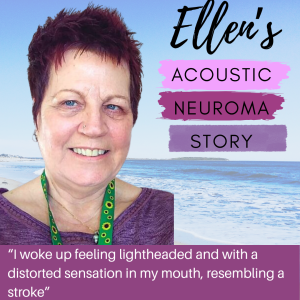
She woke feeling lightheaded and noticed an unusual sensation around her mouth. The experience was alarming enough to make her worry that something similar to a stroke might be happening.
Her husband recognised that something was wrong and contacted their GP.
Initially, Ellen was told she had an ear infection.
But her symptoms did not go away.
Instead, her balance became increasingly difficult to manage, and her everyday life began to change.
Watch Naomi tell her story in full in the Aunty M Brain Tumours Talk Show interview below, or keep reading for the written version
When Vertigo Took Over Everyday Life
As her condition progressed, Ellen experienced severe vertigo.
Even standing became difficult.
She was advised to try the Epley manoeuvre, a repositioning treatment commonly used for certain types of positional vertigo.
Unfortunately, it did not resolve her problems.
For Ellen, this was no longer simply an occasional dizzy spell.
Her balance difficulties were affecting her ability to move around safely and manage ordinary daily activities.
She also had an office-based job that required driving.
With her balance so badly affected, returning to work was no longer straightforward.
Her husband was becoming increasingly concerned. He had known people who had died from brain tumours and could see that Ellen was becoming more unsteady and clumsy.
There was clearly something happening that needed further investigation.
The Scan That Finally Revealed an Acoustic Neuroma
Ellen underwent a scan in March 2015.
On 20 April 2015, she received her diagnosis.
She had an acoustic neuroma — a tumour growing on the nerve involved in hearing and balance.
The tumour was described as benign, meaning non-cancerous.
For Ellen, hearing the word benign brought a degree of relief.
But as many people affected by non-cancerous brain tumours know, benign does not necessarily mean harmless.
An acoustic neuroma can still affect hearing, balance and everyday independence because of where it grows.
Ellen had already experienced the effects of the tumour long before anyone knew it was there.
Now she finally had an explanation.
But she also had to begin coming to terms with living with a brain tumour.
Eight Years of Watch and Wait
At the time of our interview, Ellen had been living with her acoustic neuroma diagnosis for approximately eight years.
Her tumour was being managed through a watch-and-wait approach.
This means monitoring a tumour, usually with MRI scans and specialist assessments, rather than immediately treating it with surgery or radiotherapy.
For some people with acoustic neuroma, particularly when the tumour is stable or intervention carries significant risks, monitoring may be the most appropriate approach.
But watching and waiting can bring its own emotional challenges.
There may be no operation to mark the end of treatment.
Instead, the tumour remains something a person must continue to live with and think about.
There can be ongoing symptoms, appointments and uncertainty about what future scans might show.
Ellen’s experience shows that people who have not undergone brain surgery can still be profoundly affected by their diagnosis.
Living with a brain tumour is not necessarily easier simply because it has not been removed.
The Emotional Impact of a Benign Brain Tumour
One of the most important parts of Ellen’s interview is her honesty about the emotional impact of her diagnosis.
There is sometimes an assumption that being told a tumour is non-cancerous should immediately make everything feel better.
But the reality can be very different.
Ellen still had to adjust to her symptoms, changes to her independence and the knowledge that she was living with a tumour.
There was also the emotional difficulty of explaining something to other people that they could not necessarily see.
During our conversation, we discussed the importance of being kind to yourself after a brain tumour diagnosis.
It can take time to understand what has happened and how it may affect your life.
There may be days when you cope well and others when everything feels more difficult.
That does not mean you are failing to cope.
It means you are dealing with something significant.
Living With an Invisible Illness
One of the subjects Ellen and I spoke about was the invisible nature of many brain tumour symptoms.
Someone can look perfectly well while struggling with dizziness, fatigue, hearing difficulties or emotional exhaustion.
Friends and family may see someone smiling, chatting or getting on with their day and assume everything is fine.
But appearances do not always reflect how someone is feeling.
Ellen described the frustration of people commenting on how well she looked, even on days when she was struggling.
It is something I know many people in our brain tumour community will recognise.
During the conversation, we even joked that sometimes you wish people could see what was happening on the inside.
The humour is there, but so is a serious point.
You do not have to look unwell to be living with the effects of a brain tumour.
And you should not have to prove how difficult something is before people take it seriously.
Finding a Community That Understands
After her diagnosis, Ellen experienced feelings of loneliness and isolation.
Although she had people around her, finding someone who truly understood what living with an acoustic neuroma felt like was different.
That experience stayed with her.
Ellen wanted to make sure that other people receiving the same diagnosis did not feel as alone as she had.
She became involved in supporting other people affected by brain tumours, including through an online Facebook community.
Importantly, the group was not just for patients.
Carers, family members and friends were also welcome.
That reflects something we talk about regularly on Aunty M Brain Tumours: a brain tumour diagnosis affects the whole family, not only the person who has the tumour.
Having somewhere to ask questions, share experiences or simply talk to people who understand can make a meaningful difference.
For Ellen, helping others became an important part of living with her diagnosis.
Turning Her 60th Birthday Into Something Positive
Ellen’s fundraising journey began around her 60th birthday.
Rather than focusing solely on celebrating a milestone birthday, she wanted to do something that could help other people.
She began supporting brain tumour charities through fundraising and awareness activities.
Her motivation came partly from her own experience of isolation after diagnosis.
She knew how difficult it could be to find understanding and support.
If her efforts helped even one person feel less alone, they would have achieved something important.
It was a way of turning a difficult personal experience into something that could benefit the wider brain tumour community.
Maid in Kernow: How Crochet Became Part of Ellen’s Fundraising
One of the loveliest parts of Ellen’s story is her creativity.
Ellen enjoys crochet and creates handmade items under the name Maid in Kernow.
For her, crochet is more than a hobby.
It is something relaxing, enjoyable and rewarding that also gives her an opportunity to help others.
Her handmade creations have attracted interest and have become part of her fundraising efforts.
Rather than keeping everything she makes, Ellen has donated crochet creations to charities, knowing they could bring a smile to somebody else’s face.
During our interview, Ellen spoke about a planned fundraiser involving handmade crochet gnomes in collaboration with Brainstrust.
The fundraiser brought together creativity, community and brain tumour awareness.
It also demonstrated that fundraising does not always have to involve running marathons or taking on enormous physical challenges.
Sometimes it begins with a skill you already have and something you genuinely enjoy doing.

Ellen is Fundraising For Brainstrust. Check out her crochet creations: Gnomes
Remembering Dawn: A Friendship of 60 Years
There is another very personal reason behind Ellen’s fundraising.
Ellen spoke about her close friend Dawn, whom she had known for approximately 60 years.
Their friendship had lasted through much of their lives.
Sadly, Dawn died after being diagnosed with a grade 4 brain tumour.
During our conversation, Ellen reflected on their friendship and the impact of losing someone who had been such an important part of her life.
Her fundraising became a way of honouring Dawn’s memory as well as supporting other people affected by brain tumours.
Ellen spoke about dedicating a fundraising event to her friend, with Brainstrust involved in sharing their story.
It gave the event a meaning that went far beyond raising money.
It was also about friendship, grief, remembrance and doing something positive in honour of someone she loved.

Why Brainstrust Matters to Ellen
Brainstrust is a UK brain tumour charity offering practical and emotional support to patients and their families.
Ellen’s fundraising has helped raise awareness of the charity and the support it provides.
For somebody living with an acoustic neuroma, having access to clear information and people who understand the diagnosis can be extremely valuable.
That is especially true when living with a tumour under long-term monitoring.
There may be questions about scans, symptoms, hearing, balance, treatment decisions and the emotional impact of uncertainty.
Although charities cannot replace medical advice, they can help people feel better informed and less isolated.
Ellen’s fundraising is her way of contributing to that support.
Through crochet, community and remembrance, she has found ways to help other people while honouring her friend’s memory.
Find out more about Brainstrust:
https://brainstrust.org.uk/
Maid in Kernow:
https://www.facebook.com/
Ellen is Fundraising For Brainstrust. Check out her crochet creations: Gnomes
What Ellen Wants Other People to Know
A central message running through Ellen’s story is that nobody should have to feel alone after a brain tumour diagnosis.
Being told you have a benign tumour does not erase the difficulties it may cause.
Living with an acoustic neuroma can affect your hearing, balance, independence and emotional wellbeing.
Some days will be easier than others.
Ellen encourages people to be compassionate towards themselves and to seek understanding from those who have experienced something similar.
Her journey also shows that helping other people can take many forms.
It might be listening to somebody who needs to talk.
It might be creating an online community.
Or it might be making handmade crochet gifts that raise money and bring smiles to people’s faces.
Ellen has found a way to make her experience count.
And in doing so, she is helping others feel heard and supported.
About Ellen’s Tumour: What Is an Acoustic Neuroma?
An acoustic neuroma, also called a vestibular schwannoma, is a usually non-cancerous brain tumour that develops from Schwann cells associated with the vestibular nerve.
This nerve carries balance information between the inner ear and brain and runs alongside the nerve responsible for hearing.
Acoustic neuromas usually grow slowly, although their behaviour varies from person to person.
Because of their location, even a non-cancerous tumour can cause symptoms that significantly affect everyday life.
What Are the Symptoms of an Acoustic Neuroma?
Symptoms may include:
- Hearing loss, particularly in one ear
- Tinnitus, such as ringing or buzzing in the ear
- Dizziness or vertigo
- Balance problems and unsteadiness
- A feeling of fullness in the affected ear
- Facial numbness or weakness in some cases
- Headaches or other neurological symptoms, particularly with larger tumours
Not everyone experiences the same symptoms, and many of these problems have causes unrelated to brain tumours.
However, persistent or unexplained hearing loss, especially in one ear, should be assessed by a healthcare professional.
What Does Watch and Wait Mean for an Acoustic Neuroma?
Watch and wait, sometimes called active surveillance, means that the medical team monitors the tumour rather than immediately treating it.
This may involve:
- Regular MRI scans
- Hearing tests
- Assessments of balance and other symptoms
- Follow-up appointments with the specialist team
If the tumour remains stable, monitoring may continue.
If it begins to grow or causes increasing problems, the medical team may discuss other treatment options.
The decision depends on several factors, including the tumour’s size, growth, location, symptoms and the individual’s general health.
For Ellen, watch and wait had been part of her life for approximately eight years when we spoke.
What Other Treatments Are Available?
Not every acoustic neuroma requires the same treatment.
Possible approaches include:
Surgery: An operation may be recommended to remove all or part of a tumour, particularly if it is large, growing or causing significant pressure on nearby structures.
Stereotactic radiosurgery: A highly focused form of radiotherapy may be used to control the growth of selected tumours.
Ongoing monitoring: Some tumours remain stable and can continue to be monitored without immediate intervention.
Each approach has potential benefits and risks, including possible effects on hearing, balance and facial nerve function.
Treatment decisions should always be discussed with the specialist medical team.
Ellen’s Message: You Don’t Have to Feel Alone
Ellen’s story began with unexplained symptoms, frightening vertigo and the discovery of a brain tumour.
But it did not end with the diagnosis.
Living with an acoustic neuroma under watch and wait has brought emotional and physical challenges that others may not always see.
Through her fundraising, crochet and support for the brain tumour community, Ellen has found ways to make a positive difference.
She has also honoured the memory of Dawn, a friend who meant so much to her.
For me, one of the most important parts of Ellen’s story is her wish that nobody else should have to feel as alone as she once did.
That is why sharing these experiences matters.
Whether somebody has an acoustic neuroma, another type of brain tumour, or is supporting someone they love, finding people who understand can change everything.
You don’t have to go through a brain tumour diagnosis alone.
Medical information is provided for general awareness and does not replace advice from your own specialist team. Ellen’s experiences and fundraising plans are described as they were shared during her original interview.
Read More Acoustic Neuroma Stories
https://auntymbraintumours.com/tag/acoustic-neuroma/
If You Have Recently Been Diagnosed With an Acoustic Neuroma
If you have landed on this page after a recent diagnosis, please know you are not alone.
Every acoustic neuroma story is different.
Some people need surgery. Others are monitored over time. Some need rehabilitation afterwards, while others recover with fewer long-term effects.
Try not to compare your journey too closely with anyone else’s.
And you do not have to walk this road alone.
Where to Go After an Acoustic Neuroma Diagnosis?
If you have been diagnosed with an acoustic neuroma, also known as a vestibular schwannoma, there are organisations that can offer information, emotional support and practical advice.
British Acoustic Neuroma Association (BANA):
BANA is a UK charity dedicated to supporting people affected by acoustic neuroma. It offers information, support and opportunities to connect with people who understand the diagnosis.
Acoustic Neuroma Association:
They are a resource to the acoustic neuroma community, informing, educating, and supporting those affected by an acoustic neuroma. Also called a vestibular schwannoma
RNID:
RNID supports people who are deaf, have hearing loss or experience tinnitus. Its resources cover hearing technology, communication, accessibility and everyday life with hearing difficulties.
Brainstrust:
They are here to help you live life with a brain tumour.
The Brain Tumour Charity:
Offers support services, counselling, information and community groups for patients and families.
Brain Tumour Support:
Here for everyone affected by a brain tumour
Brain Tumour Research:
Funds research into brain tumours and campaigns for increased awareness and investment.
NHS Audiology and Rehabilitation Services
For people experiencing hearing loss after acoustic neuroma treatment, audiology services may help assess suitable hearing technology and communication support.
Vestibular physiotherapy may also be useful where balance problems are affecting daily life.
Ask your GP or specialist team about appropriate referrals.


Claire Bullimore is an influential figure in the brain tumour community. She embarked on her brain tumour journey and was diagnosed with an intraventricular meningioma. In response to her experiences, Claire founded ‘Aunty M Brain Tumours,’ a platform dedicated to sharing brain tumour stories. Based in London, England, Claire also identifies as a blogger and speaker for Aunty M Brain Tumours, shedding light on the challenges faced by those diagnosed and amplifying their voices for better awareness and support. Through her dedication and advocacy, Claire’s efforts have been recognized by Brain Tumour Research and other organizations, spotlighting her commitment to making a positive difference for individuals impacted by brain tumours.