
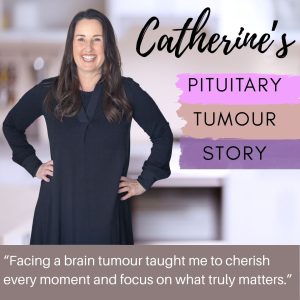
“Facing a brain tumour taught me to cherish every moment and focus on what truly matters.”
Catherine Gladwyn Story – Living with a Pituitary Tumour
Catherine’s pituitary tumour story began with symptoms that could easily have been explained away. She was exhausted. Her periods stopped. Her hair was falling out. She experienced dizziness and, perhaps most frighteningly, her memory began to fail her.
Catherine was managing a team at work, but she could sit through a meeting and then struggle to remember what had been said.
At first, they told her she was stressed. But Catherine knew her own body.
She kept pushing for answers — and eventually a blood test showed extremely high prolactin levels. Further investigations revealed a pituitary tumour at the base of her brain. Catherine has said her prolactin level was around 9,000 when the expected level was dramatically lower.
That diagnosis was the beginning of a journey involving repeated pituitary surgery, Gamma Knife radiotherapy, hormone replacement medication and learning how to build a life around a long-term health condition.
Listen to Catherine tell her story in full in the Aunty M Brain Tumours Talk Show interview below, or keep reading for the written version
“Facing a brain tumour taught me to cherish every moment and focus on what truly matters.” – Catherine
When Catherine Knew Something Was Wrong
Catherine’s symptoms began around 2011.
Looking at them individually, many had possible explanations:
- dizziness
- hair loss
- periods stopping
- extreme tiredness
- problems with her eyesight
- memory difficulties
But together, Catherine knew something wasn’t right.
One of the most frightening changes was her memory.
She has described going to the supermarket and forgetting why she was there, struggling with conversations and finding it increasingly difficult to function normally at work. At one point, she became so confused while driving around a roundabout that she knew something more serious was happening.
Yet Catherine was initially told she was stressed.
She eventually decided that she needed another opinion.
And that decision changed everything.
Finally Getting a Diagnosis
Blood tests revealed extremely abnormal hormone levels and Catherine was diagnosed with a pituitary tumour.
For Catherine, the diagnosis brought fear — but also answers.
There was finally a reason why her memory, hormones, energy and body had changed so dramatically.
This is something that comes through strongly when Catherine talks about her experience.
Being diagnosed with a tumour is frightening.
But being repeatedly told that nothing significant is wrong when you know something has changed can be frightening too.
Pituitary Surgery
Catherine underwent surgery in 2012.
Pituitary tumours can often be reached through the nose using an operation called transsphenoidal surgery, rather than requiring the type of craniotomy many people associate with brain or skull-base surgery. Catherine has described having her tumours removed this way.
One of the remarkable changes Catherine noticed after her first treatment was her memory.
She began feeling more like herself again.
Symptoms that had affected her personality, relationships and everyday life finally had an explanation.
When the Tumour Came Back
Unfortunately, Catherine’s story did not end with her first operation.
The tumour returned.
In 2014, she underwent Gamma Knife radiotherapy.
Radiotherapy can be used for some pituitary tumours when tumour remains after surgery or when a tumour grows again. Its aim is usually to control further growth.
For Catherine, treatment helped control the tumour for several years.
But it also affected the function of her pituitary gland.
The pituitary may be tiny, but it plays an enormous role in controlling hormones throughout the body.
Catherine consequently became dependent on hormone replacement medication and has spoken publicly about living with adrenal insufficiency alongside her recurring pituitary tumours.
More Tumours and More Surgery
Catherine’s tumour has proved unusually persistent.
She has publicly described undergoing four pituitary operations as well as Gamma Knife radiotherapy, with further surgeries taking place after her original operation as the tumour continued to recur.
One operation in June 2021 lasted around ten hours.
The tumour had grown close to important blood vessels, making surgery increasingly complicated. Catherine also faced the risk of a cerebrospinal fluid — or CSF — leak following surgery.
It is an important reminder that the word benign does not necessarily mean easy.
Most pituitary tumours are non-cancerous, but they can still cause significant problems because of their location and their effects on hormones and surrounding structures.
Living With the Long-Term Effects
Catherine’s treatment changed more than her scans.
She has had to adapt her everyday life around fatigue, medication and hospital appointments.
For someone who had previously worked a traditional 9-to-5 job and enjoyed being extremely active, that required a major rethink.
Eventually Catherine realised she needed work that could fit around her health rather than forcing her health to fit around work.
She started her own Virtual Assistant business and later began training other people to become Virtual Assistants.
What started partly as a way of protecting her health grew into a successful business and a new direction for her life.
How a Pituitary Tumour Changed Catherine’s Outlook
What I particularly enjoyed about talking to Catherine was that our conversation became about much more than operations and hospital appointments.
We talked about life.
About relationships.
About mental health.
About who we choose to spend our time with.
And about the strange way a serious diagnosis can suddenly make you reconsider what really matters.
Catherine has become much more protective of her energy and the people she allows into her life.
Her experience has also made conversations about illness and mortality feel less frightening and more necessary.
“Facing a brain tumour taught me to cherish every moment and focus on what truly matters.”
There is nothing sentimental about Catherine’s view of illness.
She doesn’t pretend that difficult experiences magically become positive.
Instead, she talks about accepting that life is finite — and using that knowledge to live the life you actually want.
Why Catherine Shares Her Story
Catherine continues to speak publicly about her pituitary tumour experience because some of her original symptoms were so easy to dismiss.
Hair loss.
Fatigue.
Periods stopping.
Memory problems.
Dizziness.
Changes to eyesight.
Any one of these could potentially have another explanation.
But Catherine knew that something wasn’t right.
Her message isn’t that everyone experiencing these symptoms has a pituitary tumour.
It is that persistent or unexplained changes deserve to be taken seriously.
And if you feel that something is wrong, it is okay to go back, ask more questions or seek another medical opinion.
About Pituitary Tumours
The pituitary gland is a very small gland located at the base of the brain. It produces hormones and helps control several other hormone-producing glands in the body, which is why it is sometimes called the body’s “master gland.”
Most pituitary tumours are benign, meaning non-cancerous.
However, they can still cause significant symptoms by affecting hormone production or pressing on nearby structures such as the optic nerves. Symptoms vary depending on the type and size of the tumour and which hormones are affected.
Treatment can include:
- monitoring
- medication
- surgery
- radiotherapy
- hormone replacement treatment
Not everyone with a pituitary tumour will have the same treatment or experience.
Support for People With Pituitary Conditions
The Pituitary Foundation
The Pituitary Foundation is a UK charity supporting people affected by pituitary conditions, as well as their families and carers.
They provide information about pituitary tumours, hormones, surgery, radiotherapy, adrenal insufficiency and living with a pituitary condition. They also offer patient and endocrine nurse helplines.
Visit The Pituitary Foundation
Catherine’s Message
Catherine’s story began with knowing that something wasn’t right and refusing to accept stress as the only explanation.
Since then she has been through surgery, recurrence, radiotherapy, further operations and the long-term reality of living with a pituitary condition.
But Catherine’s story isn’t only about illness.
It is also about changing the way she works, choosing where she spends her energy and appreciating the life she has now.
Thank you, Catherine, for sharing your story so openly.
You can watch the full episode here:
📺 Watch on YouTube: Watch Catherine’s Episode
🎧 Listen on the podcast: The Aunty M Brain Tumours Talk Show

Claire Bullimore is an influential figure in the brain tumour community. She embarked on her brain tumour journey and was diagnosed with an intraventricular meningioma. In response to her experiences, Claire founded ‘Aunty M Brain Tumours,’ a platform dedicated to sharing brain tumour stories. Based in London, England, Claire also identifies as a blogger and speaker for Aunty M Brain Tumours, shedding light on the challenges faced by those diagnosed and amplifying their voices for better awareness and support. Through her dedication and advocacy, Claire’s efforts have been recognized by Brain Tumour Research and other organizations, spotlighting her commitment to making a positive difference for individuals impacted by brain tumours.