
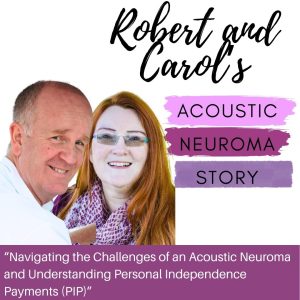
Robert and Carol Shaw share their journey dealing with Robert’s Acoustic Neuroma, a type of brain tumour and the challenges of the benefits system. Robert’s diagnosis, treatment, and the importance of faith and positivity are recounted. They highlight the misunderstandings around brain tumours and the struggles with benefits, particularly Personal Independence Payments (PIP). The system’s complexity and lack of understanding are emphasised, alongside stories of financial hardship within the brain tumour community. The interview touches on PIP assessment difficulties, discomfort in seeking support, and their organisation, Debt Relief Solutions. They stress the need for help and spotlight their commitment to aiding those facing brain tumours and financial crises in the UK.
Brain Tumours and PIP: Robert & Carol’s Acoustic Neuroma Story
When a Brain Tumour Affects More Than Your Health
A brain tumour diagnosis can change far more than your health.
It can affect your ability to work, your independence, your finances and the everyday things you once did without thinking.
For Robert and Carol Shaw, Robert’s acoustic neuroma diagnosis brought not only medical uncertainty, but another unexpected challenge: trying to navigate the benefits system and understand Personal Independence Payment (PIP).
Their experience highlights something that many people living with a brain tumour understand all too well.
Not every disability can be seen.
Symptoms That Did Not Initially Point to a Brain Tumour
Robert’s diagnosis did not happen immediately.
He had several medical appointments before the cause of his symptoms became clear. At different points, problems with his ears were thought to be caused by wax, an ear infection or ear disease.
Eventually, Robert had a scan.
It revealed something neither he nor Carol had expected: a brain tumour.
Robert had an acoustic neuroma.
Also known as a vestibular schwannoma, an acoustic neuroma is a usually non-cancerous tumour that develops on the nerve involved in hearing and balance.
Suddenly, Robert and Carol were facing an entirely different future.
Listen to Robert & Carol tell their story in full in the Aunty M Brain Tumours Talk Show interview below, or keep reading for the written version
Treatment for Robert’s Acoustic Neuroma
After his diagnosis, Robert was referred to Queen Elizabeth Hospital for specialist treatment.
His medical team decided that radiosurgery was the appropriate treatment for his acoustic neuroma.
Despite its name, radiosurgery does not involve physically removing a tumour through traditional surgery. Instead, highly focused radiation is directed at the tumour.
For Robert, treatment was only one part of what lay ahead.
The effects of his brain tumour began to influence other areas of his life — including his ability to continue working.
When a Brain Tumour Becomes a Hidden Disability
One of the difficulties Robert and Carol encountered was helping other people understand how significantly a brain tumour could affect everyday life.
Someone can look well and still be struggling.
Brain tumour patients may experience problems with balance, hearing, vision, fatigue, memory, concentration, communication or mobility. Some effects can fluctuate, while others may become long-term.
These difficulties are not necessarily obvious to somebody looking from the outside.
For Robert, his health eventually reached a point where medical retirement was recommended.
But stepping away from work brought another question.
What financial help was available?
Trying to Understand Personal Independence Payment (PIP)
Robert and Carol found themselves navigating Personal Independence Payment, commonly known as PIP.
Their experience was frustrating.
They felt that the impact of Robert’s brain tumour and hidden disability was not always understood within the benefits process.
And they are not alone in finding it difficult to explain the everyday impact of a neurological condition.
PIP is not awarded simply because someone has a particular diagnosis.
What matters is how a long-term condition or disability affects a person’s ability to carry out specific daily living and mobility activities.
That distinction is particularly important for people affected by brain tumours.
Brain Tumours Can Affect Everyday Life in Unexpected Ways
Two people with the same type of brain tumour may experience completely different difficulties.
For one person, balance may be the biggest problem.
For another, it might be fatigue, memory, vision, hearing, communication or difficulty planning and completing everyday tasks.
The effects can also change from day to day.
This is why explaining the reality of everyday life can be so important when applying for support.
Instead of concentrating only on the words “brain tumour”, it can help to describe what the condition actually prevents you from doing — or what you can only do with help, an aid, more time or significant effort.
What Is PIP?
Personal Independence Payment is a UK benefit designed to help with the extra living costs associated with a long-term physical or mental health condition or disability.
PIP has two parts:
- Daily living — for difficulties with everyday activities
- Mobility — for difficulties with getting around
A person may qualify for one or both parts.
Importantly, PIP is not means-tested. You can potentially receive it while working and having savings.
Eligibility depends on how your condition affects you, rather than the diagnosis alone.
PIP rules can change, so always check the latest GOV.UK guidance before applying.
Why Explaining Your Brain Tumour’s Impact Matters
When applying for PIP, think about what everyday life actually looks like for you.
For somebody affected by a brain tumour, that might include difficulties with:
- preparing or cooking food safely
- remembering or managing medication
- washing and dressing
- communicating or understanding information
- reading because of visual or cognitive difficulties
- managing money and making decisions
- planning or following a journey
- physically moving around safely
Not everyone with a brain tumour will experience these difficulties.
The important thing is to explain your own experience rather than what somebody with your diagnosis is expected to experience.
Think About Whether You Can Do Something Reliably
Being technically able to do something does not necessarily tell the whole story.
Think about whether you can manage an activity safely and consistently.
For example, perhaps you can prepare a meal — but only if somebody supervises you because of balance, vision or cognitive problems.
Perhaps you can walk somewhere — but doing so leaves you exhausted or unsafe.
Or perhaps you can complete an activity once, but would struggle to repeat it when needed.
These details help explain the practical impact of living with a brain tumour or its treatment.
What About Good Days and Bad Days?
This can be particularly important for people living with neurological conditions.
Brain tumour symptoms and treatment effects can fluctuate.
You may have a relatively good day followed by a day when fatigue, dizziness, headaches, cognitive problems or other symptoms make everyday tasks much harder.
PIP considers how your condition affects you over time, rather than judging you solely on one particularly good or bad day.
When completing an application or assessment, describe what happens across your normal weeks and months.
Do not minimise the difficult days simply because you sometimes manage better.
Getting Help With a PIP Application
Robert and Carol’s experience also shows why asking for help can matter.
You do not necessarily have to work through a PIP application alone.
Depending on your circumstances, support may be available from organisations such as Citizens Advice and charities familiar with disability, neurological conditions or brain tumours.
It can also help to gather relevant information you already have about how your condition affects you.
This might include information from healthcare professionals or other people involved in your care and support.
The most useful evidence is often evidence that helps explain how your condition affects your daily life, rather than simply confirming the name of your diagnosis.
What Happens After You Apply for PIP?
Some people are asked to have an assessment with a health professional if more information is needed.
An assessment may take place in person, at home, by telephone or by video.
You can have somebody with you, such as a friend, family member or support worker.
The assessment focuses on how your condition affects daily living and mobility.
If you receive a decision you believe is wrong, there is also a process for challenging it, beginning with a mandatory reconsideration.
The Financial Impact of a Brain Tumour
Robert and Carol’s story opens up a wider conversation that deserves more attention.
A brain tumour does not arrive neatly contained within hospital appointments.
It can affect whether somebody can work.
It can mean travelling regularly for treatment.
A partner may need to reduce their own working hours to provide care.
There can be additional transport costs, changes to the home, specialist equipment and other expenses.
At exactly the time a family is trying to process a frightening diagnosis, they may also find themselves worrying about money.
For some people, asking for financial support can feel uncomfortable.
But needing help after a major change in health is nothing to be ashamed of.
Robert and Carol’s Message: Ask for Help
One of the most important themes from Robert and Carol’s conversation is the value of support.
They speak openly about the difficulties they encountered and the importance of finding organisations and people who can help you understand what support may be available.
Their own experiences with financial difficulty also led them to want to help others facing similar situations.
For people affected by brain tumours, knowing where to turn can make an enormous difference.
Important Takeaways
Robert and Carol’s experience is a reminder that the impact of a brain tumour is not always visible.
A few things are particularly important to remember:
- PIP is based on how your condition affects your daily life and mobility, not simply your diagnosis.
- You can potentially receive PIP even if you are working or have savings.
- Brain tumour effects such as fatigue, balance difficulties, hearing loss, visual problems and cognitive changes may not be obvious to other people.
- If symptoms fluctuate, explain what both your better and more difficult days look like.
- Describe the help, supervision, aids or extra time you need to complete everyday activities.
- You do not have to navigate the process entirely on your own.
If You Have a Brain Tumour and Are Considering PIP
If you have arrived on this page because you are thinking about applying for PIP, start by thinking about your daily life, rather than simply your medical diagnosis.
For a few days, it may help to make notes about the activities you struggle with.
What happens when you prepare food?
Can you remember medication without prompting?
Does fatigue prevent you from completing something?
Can you travel somewhere unfamiliar independently?
Do balance or vision problems make an activity unsafe?
Do you need another person nearby?
These everyday examples can help you describe the reality of your condition more clearly.
Most importantly, be accurate.
Do not exaggerate what you experience — but do not play it down either.
Living with a brain tumour can involve difficulties that other people simply cannot see.
Those difficulties still matter.
Where to Find Help With PIP and Brain Tumour Support
For the latest information about Personal Independence Payment, always check GOV.UK.
You may also find help through:
- Citizens Advice — information and support with benefits and PIP
- The Brain Tumour Charity — information and support for people affected by brain tumours
- Brain Tumour Support — practical and emotional support
- Brainstrust — support and information for people living with a brain tumour
Robert and Carol’s story reminds us why conversations about life beyond the diagnosis are so important.
Treatment matters.
But so do work, money, independence, family life and being understood.
These are all part of living with — and beyond — a brain tumour.

Claire Bullimore is an influential figure in the brain tumour community. She embarked on her brain tumour journey and was diagnosed with an intraventricular meningioma. In response to her experiences, Claire founded ‘Aunty M Brain Tumours,’ a platform dedicated to sharing brain tumour stories. Based in London, England, Claire also identifies as a blogger and speaker for Aunty M Brain Tumours, shedding light on the challenges faced by those diagnosed and amplifying their voices for better awareness and support. Through her dedication and advocacy, Claire’s efforts have been recognized by Brain Tumour Research and other organizations, spotlighting her commitment to making a positive difference for individuals impacted by brain tumours.