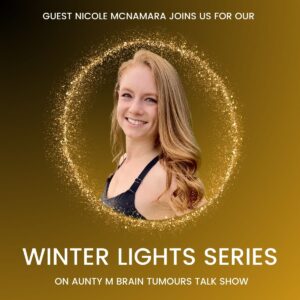
Nicole McNamara had recently married, was enjoying her dream job and felt healthier than ever. Then, in February 2020, an unexpected seizure at the gym led to the discovery of an astrocytoma. What followed was an awake craniotomy, difficult decisions about treatment, ongoing seizures and a clinical trial that gave her new hope.
Sometimes, a brain tumour diagnosis arrives when life seems to be going exactly as planned.
For Nicole McNamara, everything appeared to be falling into place.
She was newly married to her husband, Pat, enjoying a career she loved and feeling in the best physical shape of her life.
There was no reason to imagine that something serious was happening inside her brain.
But in February 2020, Nicole collapsed at the gym after experiencing a seizure.
That moment changed everything.
Medical investigations revealed an astrocytoma, a type of glioma that develops in the brain or spinal cord.
Nicole suddenly found herself navigating unfamiliar medical decisions, seeking second opinions and facing the possibility of brain surgery.
When she joined me on the Aunty M Brain Tumours Talk Show, Nicole spoke openly about her diagnosis, awake craniotomy, clinical trial, seizures, family planning and the emotional side of living with a brain tumour.
Her story highlights how much life can change after a single unexpected event — and why having the right information and support can make an enormous difference.
The Seizure That Changed Nicole’s Life
Before her diagnosis, Nicole was enjoying a particularly happy chapter of her life.
She had recently married and was thriving at work.
She was also taking care of her physical health and enjoying regular exercise.
Then, while at the gym in February 2020, she unexpectedly had a seizure and collapsed.
What had been an ordinary day suddenly became the beginning of a completely different experience.
A seizure can sometimes be the first noticeable symptom of a brain tumour, even when someone has otherwise been feeling well.
Further investigations revealed that Nicole had an astrocytoma.
It was a diagnosis she had never imagined receiving.
Instead of thinking about her newly married life and future plans, she now had to understand what was happening inside her brain and what treatment might be necessary.
When a Second Opinion Changed Everything
One of the most important moments in Nicole’s story came when she sought another medical opinion.
Initially, she had been reassured that her brain tumour was benign.
For someone hearing the word tumour for the first time, that reassurance can feel enormously significant.
But Nicole’s understanding of her diagnosis changed after a second opinion.
She was told the tumour was not benign in the way she had initially understood and that surgery would be necessary.
Its location made treatment particularly delicate.
Nicole was advised to undergo an awake craniotomy, allowing surgeons to monitor important functions while operating.
The aim was to remove as much tumour as safely possible while reducing the risk of damaging the parts of her brain involved in movement.
Without careful mapping and monitoring, there were concerns about serious neurological complications, including paralysis.
For Nicole, obtaining another opinion had made a major difference.
It helped her understand the risks and why a particular surgical approach was being recommended.
Her experience is a reminder that patients can ask questions, seek clarification and request specialist opinions when making major treatment decisions.
Watch Nicole Share Her Astrocytoma Story
In this Aunty M Brain Tumours Talk Show interview, Nicole talks openly about the seizure that led to her diagnosis, undergoing awake brain surgery and participating in a clinical trial.
We also discuss living with seizures, the difficult decisions surrounding family planning and the importance of emotional support.
Watch our interview below, or continue reading Nicole’s story.
Undergoing an Awake Craniotomy
The prospect of being awake during brain surgery can sound frightening.
But awake craniotomy is an established surgical technique used for some tumours located close to important areas of the brain.
During parts of the operation, the patient may be asked to speak, move or complete simple tasks.
This allows the surgical team to monitor brain function while working around delicate structures.
For Nicole, an awake craniotomy was recommended because of the location of her astrocytoma and the potential risks associated with removing it.
She recalls the experience as surreal.
It was difficult to imagine beforehand what being awake during brain surgery would actually feel like.
Yet the procedure was an important part of her treatment.
The operation marked another major stage in a journey that had begun with an unexpected seizure only months earlier.
However, surgery did not mean that every uncertainty had disappeared.
Nicole would still need follow-up care and further decisions about how best to manage her tumour.
A Clinical Trial That Offered New Hope
Approximately a year after surgery, Nicole became eligible to participate in a clinical drug trial.
Clinical trials are an important part of developing new treatments for brain tumours.
They allow researchers to investigate whether new medicines are safe and effective, often comparing them with existing approaches or a placebo.
Nicole’s trial involved an investigational treatment targeting tumour biology.
At first, she was receiving a placebo rather than the active medication.
Later, she switched to the active treatment.
Nicole described a significant change after receiving the drug.
Her tumour began to shrink.
For someone who had already faced brain surgery and uncertainty about the future, this was enormously encouraging.
It was also a reminder of why brain tumour research matters.
New treatments take years of scientific work, careful testing and patient participation before they may become available more widely.
Nicole’s experience highlights the contribution patients make when they choose to take part in clinical trials.
However, one patient’s response cannot predict how another person will respond to the same treatment.

Living With Seizures After Brain Surgery
Although Nicole had undergone surgery and was participating in a clinical trial, seizures continued to be part of her life.
She experienced breakthrough seizures despite taking medication.
These are seizures that occur even though someone is receiving treatment intended to control them.
For Nicole, finding the right medication combination involved considerable trial and error.
It was frustrating to experience further seizures while doing everything she could to manage her health.
Different medications and combinations were tried.
Eventually, she found greater stability using a combination of three anti-seizure medicines.
This was an important improvement in her everyday life.
But her experience demonstrates that seizure management is not always straightforward.
Some people need adjustments over time, while others may experience side effects from their medication.
Anyone continuing to experience seizures should discuss them with their neurologist or epilepsy team rather than changing prescribed treatment independently.
The Difficult Decision About Starting a Family
One of the most emotional parts of Nicole’s interview is her experience of making decisions about motherhood.
Nicole and her husband, Pat, had hoped to start a family.
But her diagnosis and treatment introduced new complications.
She received conflicting medical advice about whether it would be safe for her to become pregnant and carry a child.
These were not simple decisions.
There were concerns about her health, the treatments and medications she was taking, and what pregnancy might mean for her condition.
For Nicole, this meant reconsidering a future she and Pat had imagined together.
After weighing the advice and risks, Nicole decided that surrogacy was the safest option for her circumstances.
It was a deeply personal decision.
A brain tumour diagnosis can affect far more than medical appointments and treatment plans.
It can also change decisions about fertility, pregnancy and family life.
Nicole’s experience shows why patients may need access to specialists who understand the relationship between neurological conditions, cancer treatment, anti-seizure medication and reproductive health.
There is no single answer that is right for everybody.
What matters is having accurate information, appropriate specialist advice and the opportunity to make informed choices.
The Emotional Impact of Living With an Astrocytoma
Brain tumour treatment is often discussed in terms of scans, surgery, medication and medical appointments.
But the emotional effects can be equally significant.
Nicole’s life changed suddenly.
She went from feeling happy, healthy and settled in her career to managing a diagnosis that affected her future plans and everyday independence.
There was uncertainty surrounding treatment.
There were frustrating breakthrough seizures.
There were difficult conversations about whether she could safely carry a child.
And there was the ongoing emotional work of accepting a life that looked different from the one she had imagined.
Nicole found counselling particularly valuable.
Through Duke’s Brain Tumor Center, she accessed therapy that helped her process her experiences.
It gave her somewhere to speak openly about her fears, frustrations and the complicated emotions that can follow a diagnosis.
For Nicole, counselling became an important part of her support.
Her experience is a reminder that asking for psychological help is not a sign of weakness.
It is another way of looking after yourself while living with a serious medical condition.
Pat, Family and the Support That Made a Difference
Throughout Nicole’s diagnosis and treatment, her husband Pat has been a constant source of support.
They were newly married when her first seizure occurred.
Instead of simply enjoying the beginning of married life, they suddenly found themselves navigating hospital appointments, brain surgery and decisions about their future.
Nicole speaks with gratitude about the love and support she has received from Pat and her wider family.
She also acknowledges the medical team at Duke who helped her through treatment.
When someone is diagnosed with a brain tumour, the people closest to them are affected too.
Partners may become carers, advocates and sources of reassurance.
They may also need support as they process their own fears and uncertainties.
Nicole’s experience shows how important it is to have people who will listen, help with decisions and stand beside you when circumstances change.

Finding Understanding Through Other People’s Stories
One of the things Nicole found helpful was listening to podcasts and hearing from others affected by brain tumours.
When someone is diagnosed with an uncommon condition, it can be difficult to find people who understand what they are experiencing.
Friends and relatives may offer wonderful support, but they may not know what it feels like to have seizures, undergo brain surgery or live with uncertainty surrounding a tumour.
Hearing another patient’s story can offer a different kind of reassurance.
There may be familiar emotions, similar treatment experiences or simply the comfort of knowing that someone else understands.
This is something I have always felt strongly about through Aunty M Brain Tumours.
Our stories are not identical.
But sharing them can help us recognise that we are not alone in the things we experience.
Nicole’s willingness to speak about diagnosis, treatment, fertility and mental health makes her interview particularly valuable.
These are important conversations that deserve to be heard.
What We Can Learn From Nicole’s Experience
There are several important messages within Nicole’s astrocytoma story.
Seek clarification and second opinions. Nicole’s second opinion changed her understanding of the tumour and the surgery being recommended.
Ask about clinical trials. Depending on the tumour’s molecular characteristics and the person’s circumstances, clinical trials may provide access to investigational treatments.
Speak up about breakthrough seizures. Continued seizures deserve specialist review, even when someone is already taking medication.
Discuss fertility before making treatment decisions. Brain tumour treatment and anti-seizure medication can affect pregnancy and family planning, so specialist advice matters.
Look after your emotional wellbeing. Counselling helped Nicole work through the emotional impact of diagnosis and treatment.
Find people who understand. Family, friends, medical professionals and patient communities can all provide different forms of support.
Nicole’s experience is individual, but these conversations may help others prepare questions for their own medical teams.
About Nicole’s Tumour: What Is an Astrocytoma?
Nicole was diagnosed with an astrocytoma, a type of brain tumour belonging to the glioma family.
Astrocytomas develop from cells associated with the supportive tissue of the brain or spinal cord.
They can occur in different locations and behave differently depending on their grade and molecular characteristics.
Modern classification takes into account genetic and molecular features, including IDH mutation status.
These details help medical teams understand the tumour and recommend appropriate treatment.
Nicole’s published interview summary identifies her tumour as an astrocytoma, but does not confirm its precise grade or molecular classification.
For that reason, this article does not assign a specific tumour grade.
What Are the Symptoms of an Astrocytoma?
Symptoms depend on the tumour’s size, location and the part of the brain affected.
Possible symptoms include:
- Seizures
- Persistent or worsening headaches
- Nausea or vomiting
- Weakness or changes in movement
- Speech or language difficulties
- Changes in vision
- Memory or concentration problems
- Balance and coordination difficulties
- Changes in mood, behaviour or personality
For Nicole, an unexpected seizure at the gym was the first event that led to her diagnosis.
Not everyone experiences the same symptoms, and many of these problems can have causes unrelated to brain tumours.
A first seizure or sudden stroke-like symptoms require emergency medical assessment.
How Is an Astrocytoma Treated?
Treatment depends on the tumour’s grade, location, molecular characteristics and the person’s individual circumstances.
Possible approaches include:
Brain surgery: Surgeons may aim to remove as much of the tumour as is safely possible while protecting important brain functions.
Active monitoring: Some lower-grade tumours may be monitored with regular MRI scans rather than requiring immediate further treatment.
Radiotherapy: Radiation treatment may be recommended depending on tumour grade, growth and previous treatment.
Chemotherapy: Some patients may receive chemotherapy as part of their treatment plan.
Targeted treatment: Certain molecularly defined tumours may be eligible for targeted medicines.
Clinical trials: Research studies may offer access to investigational treatments for eligible patients.
Seizure management and rehabilitation: Neurological care, medication, rehabilitation and psychological support may also be important.
Every patient’s treatment plan should be developed with their specialist medical team.
Targeted Treatment and the Vorasidenib Clinical Trial
Nicole discussed participating in a clinical trial of vorasidenib, a medicine designed to inhibit certain mutated IDH enzymes involved in the growth of some gliomas.
The trial experience was particularly meaningful to Nicole because she initially received a placebo before later being given the active drug.
Following the change, she reported significant tumour shrinkage.
Since the original interview, vorasidenib has become an approved treatment in the United States for eligible patients aged 12 and over with grade 2 IDH-mutant astrocytoma or oligodendroglioma following surgery.
It was approved by the US Food and Drug Administration in August 2024.
Not every astrocytoma patient is eligible for this medication.
Eligibility depends on the precise diagnosis, molecular test results, treatment history and regulatory approval in the relevant country.
Patients interested in targeted treatment or clinical trials should discuss their individual circumstances with their neuro-oncology team.
Read More Astrocytoma Stories
Read more personal Astrocytoma stories on Aunty M Brain Tumours
If You Have Recently Been Diagnosed With an Astrocytoma
If you have landed on this page after an astrocytoma diagnosis, whether it is your own or someone you love, please know you are not alone.
Every astrocytoma story is different.
Astrocytomas can vary in grade, location and how they affect a person’s life. Some are slower-growing, while others are more aggressive.
Some people have surgery, radiotherapy or chemotherapy. Others may have regular scans to monitor their tumour. Some experience long-term effects, while others face different challenges during treatment and recovery.
Try not to compare your journey too closely with anyone else’s.
Reading other people’s experiences can offer comfort, understanding and reassurance. However, another person’s diagnosis or outcome does not determine what will happen to you.
Take things at your own pace, ask questions and remember that you do not have to face this journey alone.
Where to Go After an Astrocytoma Diagnosis?
If you or someone you care about has been diagnosed with an astrocytoma, there are organisations offering information, emotional support, practical advice and opportunities to connect with others.
Astro Brain Tumour Fund
A UK charity dedicated to supporting people affected by low-grade gliomas, including Grade 1 and Grade 2 astrocytomas.
The charity provides information, opportunities to connect with others and funding for research into low-grade brain tumours.
The Brain Tumour Charity
Provides information about different types and grades of astrocytoma, possible treatments and living with a brain tumour.
It also offers emotional support, support groups and resources for patients, families and carers.
Visit The Brain Tumour Charity
Read its information about astrocytomas
brainstrust
Offers practical and emotional support to people living with brain tumours, including those affected by low-grade and high-grade gliomas.
Its services include individual support, coaching, information and opportunities to connect with others who understand life with a brain tumour.
Brain Tumour Support
A UK charity providing support for anyone affected by a brain tumour, including patients, families, carers and loved ones.
It offers individual and group support, opportunities to connect with others and specialist emotional support.
Brain Tumour Research
Funds research into brain tumours and campaigns for greater awareness and investment in research.
Its work aims to improve understanding, develop better treatments and ultimately find cures for all types of brain tumours.
NHS Neuro-Oncology and Rehabilitation Services
Your specialist medical team can help you understand your particular astrocytoma diagnosis, treatment options and follow-up care.
Depending on your needs, additional support may include physiotherapy, occupational therapy, speech and language therapy, psychological support or help managing seizures and fatigue.
Ask your GP, specialist nurse or neuro-oncology team about appropriate referrals.
Would You Like to Share Your Astrocytoma Story?
At Aunty M Brain Tumours, we believe every person’s experience deserves to be heard.
Whether you have recently been diagnosed, are undergoing treatment, living with long-term effects or supporting someone you love, your experience could help another person feel less alone.
Find out how to share your brain tumour story
Nicole’s Message: Life After an Unexpected Diagnosis
Nicole’s experience began with a seizure at the gym when she was enjoying a happy, healthy chapter of her life.
The diagnosis that followed changed the future she and Pat had imagined.
There was the fear of brain surgery, the importance of seeking another medical opinion, the frustration of breakthrough seizures and the difficult decisions surrounding motherhood.
But there was also hope through clinical research, support from loved ones and the reassurance of finding people who understood.
For me, one of the most important parts of Nicole’s story is her willingness to talk about subjects that are not always easy to discuss.
Brain tumour care is not simply about removing or treating the tumour.
It is also about helping people manage seizures, protect their quality of life, make decisions about their future and find emotional support when they need it.
Nicole’s story is another reminder of why sharing our experiences matters.
Thank you, Nicole, for sharing your journey with Aunty M Brain Tumours.
Every brain tumour story deserves to be heard.
This article reflects Nicole’s experiences as shared in her original interview and the accompanying show notes. Medical information is provided for general awareness and should not replace advice from an individual’s specialist healthcare team.

Claire Bullimore is an influential figure in the brain tumour community. She embarked on her brain tumour journey and was diagnosed with an intraventricular meningioma. In response to her experiences, Claire founded ‘Aunty M Brain Tumours,’ a platform dedicated to sharing brain tumour stories. Based in London, England, Claire also identifies as a blogger and speaker for Aunty M Brain Tumours, shedding light on the challenges faced by those diagnosed and amplifying their voices for better awareness and support. Through her dedication and advocacy, Claire’s efforts have been recognized by Brain Tumour Research and other organizations, spotlighting her commitment to making a positive difference for individuals impacted by brain tumours.