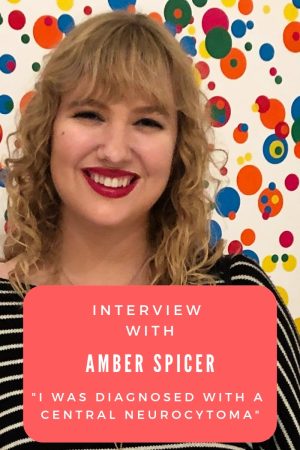
When Amber Spicer suddenly forgot how to get home from work, she had no idea she was about to be diagnosed with a rare central neurocytoma. Five days later, she underwent brain surgery, followed by Gamma Knife treatment for the remaining tumour. Amber shares how her diagnosis changed her outlook on life, relationships and the importance of making every day count.
On 23 October 2016, Amber Spicer was driving home from work when something frightening happened.
She suddenly couldn’t remember how to get home.
Confused and disoriented, Amber called her boyfriend and began reading the street signs to him.
He told her she was just two blocks away from home.
But Amber had no idea where she was.
By the time she reached the hospital, her condition had deteriorated. She was struggling to walk, couldn’t raise her arms and was unable to remember basic personal information.
A CT scan revealed a problem inside her brain.
Amber was diagnosed with a central neurocytoma, a rare brain tumour that usually develops within the fluid-filled spaces deep inside the brain.
Just five days later, she underwent a craniotomy.
Further treatment followed in May 2017, when she received Gamma Knife radiosurgery for the remaining tumour that had begun growing.
But Amber’s story is about far more than her diagnosis.
When she shared her experience with Aunty M Brain Tumours, she spoke about the unexpected changes to her relationships, the importance of finding other survivors and her decision to embrace life through a challenge she called 25 and Alive.
This is Amber Spicer’s central neurocytoma story.
The Day Amber Forgot How to Get Home
For Amber, the events of 23 October 2016 began like an ordinary journey home from work.
She had travelled the route before, but suddenly she couldn’t recognise where she was.
Unsure what to do, she called her boyfriend.
As she read the street signs aloud, he realised she was only a short distance from home.
He asked whether she needed to go to hospital because she sounded so confused.
Her symptoms continued to worsen.
By the time Amber arrived at hospital, she could no longer walk properly or raise her arms.
She was also struggling to remember basic information, including her Social Security number and the year she was born.
A CT scan was arranged.
Then a nurse entered the room and delivered news Amber would never forget.
“You have a big problem.”
The scan had revealed a mass inside her brain.
Amber was diagnosed with a central neurocytoma.
What had started as a confusing journey home had become a life-changing medical emergency.
The Symptoms Amber Had Been Living With
Looking back, Amber realised that she had experienced several neurological symptoms before her diagnosis.
At the time, however, she had not connected them.
She had suffered from almost daily migraines, often accompanied by flashing visual auras and vomiting.
She also experienced a dark spot in her vision and occasional numbness in her arms.
Another unusual symptom was a persistent sound in her right ear.
Amber described hearing her pulse, accompanied by a crunching sensation.
In the mornings, she sometimes woke to find that her vision seemed covered in spiderwebs.
Each symptom was unsettling, but Amber had not imagined that a brain tumour could be responsible.
Looking back after her diagnosis, she felt that the warning signs seemed obvious.
At the time, though, even considering the possibility of a brain tumour had felt dramatic.
It was only when her confusion became severe that she received the investigations that revealed what was happening.
Brain Surgery Just Five Days After Diagnosis
On 28 October 2016, five days after her diagnosis, Amber underwent a craniotomy to treat her central neurocytoma.
It was an enormous experience for somebody who had never previously undergone an operation.
Amber had not even stayed overnight in hospital before.
She had never needed an intravenous drip, let alone major brain surgery.
Suddenly, she was facing an operation on one of the most delicate and complex parts of the body.
Central neurocytomas usually develop inside the ventricles, the fluid-filled spaces within the brain.
Their location can make surgery challenging because they may be close to structures responsible for important neurological functions.
Although surgery was an important part of Amber’s treatment, some tumour remained afterwards.
She would need further treatment several months later.
Gamma Knife Radiosurgery in May 2017
On 15 May 2017, Amber underwent Gamma Knife radiosurgery at Vidant Medical Center in Greenville, North Carolina.
The treatment was recommended because some tumour had remained after her craniotomy and was beginning to grow.
Despite the name, Gamma Knife does not involve a surgical knife.
It is a form of stereotactic radiosurgery, which uses precisely focused radiation to target abnormal tissue.
For Amber, the aim was to treat the remaining central neurocytoma.
Her treatment involved both major brain surgery and subsequent focused radiation.
But as she recovered, Amber began noticing an enormous difference in her health.
Many of the symptoms she had lived with before diagnosis had disappeared.
Life Without Daily Migraines
One of the biggest changes Amber noticed after treatment was the improvement in her everyday life.
She had become so accustomed to migraines and neurological symptoms that she had almost forgotten what it felt like to live without them.
Now, she could enjoy activities without the constant interruption of severe headaches, vomiting and visual disturbances.
Amber felt fortunate that she had not experienced significant lasting adverse effects from her surgery and treatment.
Her experience had been frightening, but she was grateful for the improvement in her health.
For her, simply being able to enjoy an ordinary day felt different.
Things she might previously have taken for granted had become more meaningful.
Living With a Central Neurocytoma: Follow-Up MRI Scans
Although Amber was feeling well, her medical journey still involved regular monitoring.
When she shared her story in February 2020, she was travelling approximately 15 hours to Vidant Medical Center in Greenville, North Carolina, for annual MRI scans.
These follow-up appointments were important because central neurocytomas can sometimes regrow, particularly when some tumour remains after surgery.
Amber understood the importance of continuing to monitor her condition.
She also recognised how fortunate she felt to have experienced such a significant improvement in her health.
Her story illustrates how somebody can be recovering well and enjoying life while still needing ongoing specialist care.
The Unexpected Loneliness of Being a Brain Tumour Survivor
When I asked Amber about the toughest challenge brain tumour survivors face, her answer was not about surgery or scans.
It was loneliness.
Amber explained that a brain tumour diagnosis could change relationships in ways she had never expected.
Some people she thought would always be there for her disappeared from her life.
Others, whom she had not expected to become particularly close to, offered extraordinary support.
It was a difficult experience.
She discovered that many people had never known somebody with a brain tumour and did not always feel comfortable talking about it.
Some seemed unsure what to say or how to respond.
After joining support groups during recovery, Amber realised that changes in friendships and relationships were experiences other survivors recognised too.
She heard from people who had experienced difficulties with friends, partners and family members following their diagnoses.
It helped her understand that she was not alone.
Finding People Who Understood Central Neurocytoma
Because central neurocytoma is such a rare diagnosis, Amber found it particularly helpful to connect with people who had experienced the same tumour type.
Alongside another survivor, she became involved in a private Facebook group bringing together people affected by central neurocytoma.
The group offered somewhere to share experiences and talk about the challenges of living with a rare brain tumour.
For Amber, it was important that people could speak openly with others who understood.
Sometimes friends and family provide wonderful support but cannot fully understand what it feels like to face brain surgery and the uncertainty of future scans.
Having somebody who has been through a similar experience can make an enormous difference.
Amber encouraged anyone struggling with isolation to reach out to other survivors and build supportive connections.
The Friend Who Inspired Amber Through Brain Surgery
When I asked Amber who her personal hero was, she spoke about her friend Johnathan.
She had known him since they were beginning high school.
At that time, Johnathan had been facing his own battle with brain cancer.
Amber remembered his bravery and the way he approached such a frightening experience at a young age.
Years later, when she received her central neurocytoma diagnosis, his experience became an important source of strength.
She thought about everything Johnathan had been through and how he had continued moving forward.
At the time of Amber’s interview, he had been cancer-free for more than ten years and had a wife and family.
Knowing his story helped Amber face her own treatment.
It also reminded her that the people around us can influence how we approach difficult experiences, sometimes long after those experiences have taken place.
Twenty-Five and Alive: Making Every Day Count After Brain Surgery
One of my favourite parts of Amber’s story is what she decided to do after treatment.
She wanted to make the most of her second chance at life.
Rather than allowing fear to control every decision, Amber challenged herself to try new experiences.
She created a list of 25 new things to do before turning 26.
A friend gave the challenge a wonderful name:
“25 and Alive.”
For Amber, the challenge was about embracing opportunities that she might previously have avoided.
It encouraged her to say yes more often, try something different and stop automatically turning down experiences because they felt uncomfortable.
After everything she had been through, she wanted to enjoy life.
Dancing With a Stranger in Italy
One of Amber’s most memorable experiences happened in a bar in Italy.
She agreed to dance with a stranger.
It might sound like a small thing, but Amber explained that it was completely outside her comfort zone.
Nobody else in the bar was dancing.
And even when other people were dancing, Amber was not usually somebody who would get up and join them.
This time, however, she said yes.
For Amber, it became one of the most frightening — and exciting — experiences of her challenge.
There was something wonderfully liberating about doing something simply because she had the opportunity.
After having lived through a brain tumour diagnosis and treatment, she was becoming more willing to embrace life’s unexpected moments.
Finding Purpose Through Helping Others
When Amber shared her story, she was working in disaster recovery as a Volunteer Operations Coordinator.
Her work focused on supporting communities affected by the devastating floods in South Louisiana in August 2016.
Thousands of homes and families had been affected, and recovery efforts required considerable help from volunteers.
Amber was involved in coordinating those efforts.
It was meaningful work, particularly for somebody who had experienced a major medical crisis herself.
She understood that unexpected events could turn people’s lives upside down.
Through her work, she was helping families and communities rebuild after a different kind of disaster.
It also gave her an opportunity to focus on making a positive difference in other people’s lives.
Amber’s Ambition to Work in an Art Museum
Amber also had ambitions of her own.
She loved travelling and was looking forward to attending a graduate school reunion in San Francisco.
Her long-term career goal was to become a Collections Manager for an art museum.
It was an ambition that reflected her interests beyond her brain tumour experience.
She had plans, opportunities and places she wanted to visit.
Her diagnosis had changed her outlook, but it had not removed her desire to build a fulfilling future.
A Rather Unusual Souvenir From Brain Surgery
When I asked Amber to share something people might not know about her, she gave an answer I wasn’t expecting.
After her craniotomy, she kept the surgical staples that had been removed from her head.
She also kept the tool used to remove them.
The staples and tool were placed in a tiny jar on a shelf in her home.
It is certainly an unusual souvenir!
But I think it is also a wonderfully personal reminder of everything Amber had experienced.
For some people, a surgical scar is enough of a reminder.
For Amber, the tiny jar of staples became something tangible from that extraordinary chapter of her life.
It is one of those little details that makes her story memorable.
Amber’s Advice to Anyone Facing a Brain Tumour Diagnosis
When I asked Amber what advice she would offer to somebody facing a daunting diagnosis, she spoke about finding strength.
She had surprised herself with how she responded to her own diagnosis.
People close to her had commented on how bravely she had faced surgery and treatment.
But Amber admitted that she had surprised herself too.
“You are SO much stronger than you think!”
She believed people sometimes discover strengths they never realised they had when they face difficult circumstances.
Not everybody will need to draw on that strength in the same way.
And having a brain tumour does not mean someone must feel strong or positive every day.
Amber’s message was about recognising that difficult experiences can reveal qualities you might never have known you possessed.
For her, recovery also meant finding new opportunities and appreciating life beyond the diagnosis.
My Thoughts: More Than a Central Neurocytoma Diagnosis
What stands out to me about Amber’s story is how suddenly everything changed.
One moment, she was driving home from work.
The next, she was confused, frightened and unable to remember how to get home, even though she was only two blocks away.
Five days later, she underwent brain surgery.
But what I particularly enjoyed hearing about was the way Amber approached life afterwards.
Her 25 and Alive challenge is such a memorable idea.
I love that she didn’t choose to do only enormous, expensive or extraordinary things.
Sometimes it was something as simple as agreeing to dance with somebody in a bar in Italy.
For Amber, that was a big step outside her comfort zone.
And I think there is a lovely lesson in that.
Life after a brain tumour does not have to be about proving anything to anybody else. Sometimes it is simply about being able to enjoy an opportunity that you might once have turned down.
I also appreciated Amber’s honesty about friendships.
We often talk about the support people receive after a diagnosis, but perhaps not enough about the relationships that change or disappear.
Finding other people who understand can make a real difference.
Amber’s story reminds us that everyone experiences recovery differently. Not every survivor feels physically well after treatment, and nobody should feel pressured to achieve something extraordinary.
But for Amber, her experience encouraged her to embrace new opportunities, help others and make the most of the life ahead of her.
And I still smile at the thought of that little jar of surgical staples!
Thank you, Amber, for sharing your experience with me and the Aunty M Brain Tumours community.
I hope your story helps somebody else facing a central neurocytoma diagnosis feel less alone.
What Is a Central Neurocytoma?
A central neurocytoma is a rare brain tumour that usually develops inside the ventricles, the fluid-filled spaces deep within the brain.
The ventricles contain cerebrospinal fluid (CSF), which helps protect and support the brain and spinal cord.
Central neurocytomas most commonly affect young adults and generally grow relatively slowly.
They are usually classified as WHO grade 2 brain tumours.
Although they are often low-grade, their location can make them medically serious.
A central neurocytoma may obstruct the normal flow of cerebrospinal fluid, causing a build-up of fluid inside the brain known as hydrocephalus.
This can increase pressure within the skull and cause neurological symptoms.
What Symptoms Can a Central Neurocytoma Cause?
Symptoms vary depending on the tumour’s size, location and whether it affects cerebrospinal fluid circulation.
Possible symptoms include:
- Persistent or worsening headaches
- Nausea and vomiting
- Blurred or double vision
- Changes in memory or concentration
- Confusion
- Dizziness or balance difficulties
- Weakness or other neurological changes
- Seizures
Not everyone experiences the same symptoms, and these difficulties can have many different causes.
Amber described migraines, vomiting, visual disturbances, numbness and severe confusion before her diagnosis.
Central Neurocytoma Frequently Asked Questions
Is a Central Neurocytoma Cancerous?
Central neurocytomas are generally low-grade brain tumours, most commonly classified as WHO grade 2.
They usually grow slowly and often have favourable outcomes following appropriate treatment.
However, they can still cause significant symptoms and may regrow, which is why specialist treatment and monitoring are important.
How Is a Central Neurocytoma Diagnosed?
MRI scans are commonly used to identify and assess a brain tumour.
CT scans may also be used, particularly when somebody attends hospital with sudden neurological symptoms.
A definitive diagnosis usually requires examination of tumour tissue by a specialist pathologist.
What Treatment Is Available for Central Neurocytoma?
Surgery is often the main treatment.
The aim is to remove as much tumour as possible without causing unnecessary damage to surrounding brain structures.
If some tumour remains, or the tumour begins growing again, doctors may consider radiotherapy or stereotactic radiosurgery.
Treatment decisions depend on the individual circumstances.
What Is Gamma Knife Radiosurgery?
Gamma Knife is a type of stereotactic radiosurgery that delivers highly focused radiation to a precise area.
Despite its name, it does not involve a surgical knife.
It may be used to treat remaining or recurrent central neurocytoma when appropriate.
Amber underwent Gamma Knife treatment in May 2017 after scans showed growth in tumour that had remained following her craniotomy.
Can a Central Neurocytoma Grow Back?
Yes.
Some central neurocytomas may recur or grow after treatment.
The risk depends on several factors, including how much tumour was removed and the tumour’s biological characteristics.
Follow-up MRI scans allow specialists to monitor for changes.
There is no single recurrence percentage that accurately predicts the outcome for every patient.
How Often Are MRI Scans Needed After Central Neurocytoma Treatment?
Follow-up arrangements vary.
Specialists consider the treatment received, whether any tumour remains and the person’s scan history.
Some patients need more frequent scans, while others move to longer intervals when their condition remains stable.
Amber described travelling for annual MRI scans when she shared her story in 2020.
Central Neurocytoma Information and Support
Because central neurocytoma is rare, finding reliable information and people with a similar diagnosis can be difficult.
These resources may help.
National Cancer Institute — Rare Brain and Spine Tumours
Information about rare brain tumour diagnosis, treatment, follow-up scans and specialist care.
Read the National Cancer Institute’s Guide
Central Neurocytoma — Clinical Information
A peer-reviewed medical overview covering symptoms, diagnosis, surgery and radiotherapy.
Read the Central Neurocytoma Medical Review
Brainstrust — Brain Tumour Support
Brainstrust provides practical guidance, emotional support and opportunities to connect with other people affected by brain tumours.
Connect With Amber Spicer
Amber shared her travels and experiences through Instagram.
Instagram: @spicera
She also encouraged other central neurocytoma survivors to reach out and connect with people who understood their diagnosis.
These contact details were shared with her original interview in February 2020 and may have changed.
Read More Central Neurocytoma Stories
Central neurocytoma is rare, and hearing from other people with the same diagnosis can be especially valuable.
At Aunty M Brain Tumours, I share personal experiences to help people understand the realities of treatment and life afterwards.
Meagan Sutherland’s Central Neurocytoma Story
Meagan was diagnosed at just 18 years old after experiencing double vision. Her story includes brain surgery, Gamma Knife treatment, rehabilitation, aphasia and the emotional challenges of recovery.
Explore More Central Neurocytoma Stories
Discover other personal accounts of diagnosis, treatment and recovery from people affected by this rare brain tumour.
Every experience is different, but sharing stories can help people feel understood and less alone.
Would you like to share your own story?
If you have been affected by a central neurocytoma or another brain tumour and would like to help others through your experience, I would love to hear from you.
Medical disclaimer: Amber’s story reflects her personal experience as shared in February 2020. The general medical information is provided for awareness and support and is not a substitute for professional medical advice. Always discuss your diagnosis, symptoms and treatment options with your specialist healthcare team.

Claire Bullimore is an influential figure in the brain tumour community. She embarked on her brain tumour journey and was diagnosed with an intraventricular meningioma. In response to her experiences, Claire founded ‘Aunty M Brain Tumours,’ a platform dedicated to sharing brain tumour stories. Based in London, England, Claire also identifies as a blogger and speaker for Aunty M Brain Tumours, shedding light on the challenges faced by those diagnosed and amplifying their voices for better awareness and support. Through her dedication and advocacy, Claire’s efforts have been recognized by Brain Tumour Research and other organizations, spotlighting her commitment to making a positive difference for individuals impacted by brain tumours.