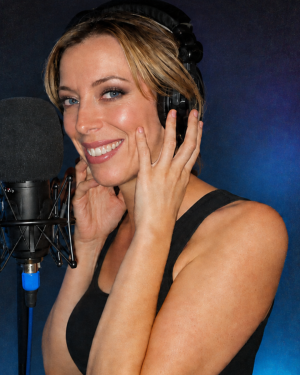
Living with word-finding difficulties and paraphasia after brain tumour surgery has been one of my long-term challenges. But something I never expected was how singing and a simple karaoke app would help me reconnect with something I thought I had lost forever.
Have you ever known exactly what you wanted to say, but your brain simply wouldn’t let you find the words?
Or perhaps you’ve said a completely different word from the one you were thinking?
For most people, these little mistakes happen occasionally. But for someone living with speech and language difficulties after brain surgery, they can become part of everyday life.
I’m Claire Bullimore, founder of Aunty M Brain Tumours, and since having surgery to remove a large 10cm intraventricular meningioma, I’ve experienced ongoing problems with speech, memory and finding the right words.
One of those difficulties is something called paraphasia.
Yet despite struggling to find words during an ordinary conversation, I’ve discovered something rather wonderful.
I can still sing!
Well, perhaps not quite like Whitney Houston, but that’s never stopped me from trying!
And believe it or not, I’ve even recorded a karaoke duet with James Arthur through an app called Smule.
But to explain why that means so much to me, I need to take you back to my childhood.
My Childhood Love of Singing
I’ve always loved music.
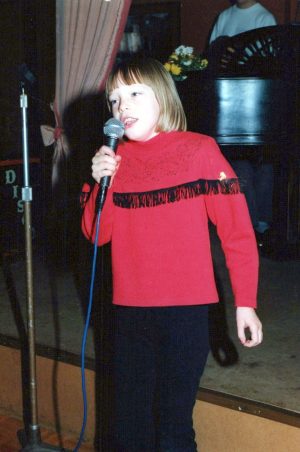
As a little girl, I would spend hours singing along to the radio, using my hairbrush as a microphone and imagining I was performing in front of thousands of people.
I’d wave to my invisible audience and thank them for their applause.
I was quite the little pop star in my own living room!
When I was about five years old, my parents bought me a Fisher-Price cassette tape recorder.
It came with Disney sing-along songs, and I absolutely loved it.
I’d spend hours recording myself singing, playing the tapes back and pretending I was a famous singer.
As I got older, my musical tastes moved on from Disney to Kylie Minogue, Whitney Houston, Madonna and Take That.
Music was always something that made me happy.
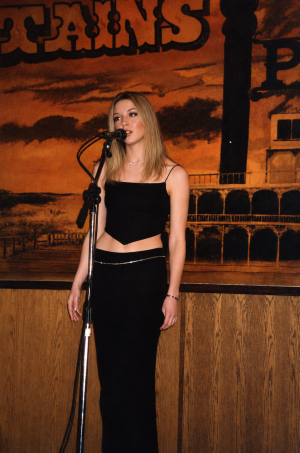
Eventually, I started going to karaoke nights.
While I was at college, I had a weekend job, and a lot of my hard-earned money went towards buying karaoke discs and equipment.
I’d invite friends over, get the microphones out and spend hours singing duets.
I wasn’t necessarily the best singer in the world, but that didn’t matter.
Singing was something I loved, and I couldn’t imagine my life without it.
 |
 |
When Brain Surgery Changed My Speech
After my brain tumour surgery, life was very different.
I knew recovery wasn’t going to happen overnight.
My brain had been through an enormous amount, and I was trying to adjust to difficulties I hadn’t experienced before.
Speaking wasn’t as straightforward as it used to be.
Sometimes I knew exactly what I wanted to say, but the word simply wouldn’t come out.
Other times, the wrong word would appear instead.
It could be incredibly frustrating because, in my mind, I knew what I meant.
But what came out of my mouth wasn’t always what I had intended.
These word-finding difficulties have remained part of my life long after surgery.
What I didn’t realise in those early weeks was that my difficulties with language were also going to affect something I had loved since childhood.
Singing.
The Heartbreaking Moment I Couldn’t Sing
When I first came home from hospital, everything felt overwhelming.
I didn’t want to confuse my brain any more than it already was, so I avoided listening to the radio, watching television and singing.
I thought giving myself some quiet time might help.
But after a week or two, I decided to turn the radio on.
A familiar song came on, and naturally, I wanted to sing along.
Except something very strange happened.
Nothing came out.
I knew the song. I knew the melody. I knew I wanted to sing.
But I couldn’t get the words out.
And when I did manage to say something, it wasn’t the correct word.
It was such a strange and upsetting experience.
I remember thinking:
“I’ll never be able to sing again.”
For someone who had spent so much of her childhood and teenage years singing, that thought was heartbreaking.
Brain surgery had already changed so much in my life.
Was I really going to lose singing as well?
Discovering a Way Back Through Karaoke
I wasn’t quite ready to give up.
Thankfully, I still had all my old karaoke discs and equipment.
I wondered whether seeing the words on a screen might help me sing again.
So I decided to try.
It certainly wasn’t easy.
At first, trying to read the lyrics, follow the music and get my voice to cooperate felt almost impossible.
My brain struggled to keep up.
Sometimes the words appeared on the screen, but I couldn’t say them quickly enough.
Other times, I would lose my place or sing the wrong word.
It could become mentally exhausting.
But instead of starting with complicated songs, I chose slower, simpler ones.
I practised a little at a time.
And gradually, things started to change.
I began finding it easier to sing along when I could see the lyrics.
The music provided a rhythm, and the words on the screen gave me something to follow.
I was singing again.
It wasn’t exactly how I used to sing before surgery, but it was something.
And that meant the world to me.
What Is Paraphasia After Brain Surgery?
One of the speech difficulties I experience is called paraphasia.
Paraphasia is when someone unintentionally substitutes an incorrect word or sound while speaking.
For example, a person might say “chair” when they mean “table”, or mix up some of the sounds in a word.
There are different forms of paraphasia.
- Semantic paraphasia: Saying a related but incorrect word, such as “dog” instead of “cat”.
- Phonemic paraphasia: Mixing up, replacing or leaving out sounds within a word.
- Neologisms: Producing words that aren’t recognisable words.
Paraphasia can occur as part of aphasia, a language disorder that can develop following damage to the brain, including after a brain tumour or brain injury.
Word-finding difficulties are also common.
For me, one of the hardest things is that I often know what I want to say.
The thought is there.
The meaning is there.
But finding the correct word and getting it out can be another matter altogether.
It’s important to understand that having speech or language difficulties doesn’t mean someone has lost their intelligence or has nothing to say.
Sometimes we just need a little more time to get our words out.
And that patience can make an enormous difference.
Why Can Some People Sing More Easily Than They Speak?
This was something I became fascinated by during my recovery.
How could I struggle to find the right words in an ordinary conversation yet manage to sing along to a familiar song?
Interestingly, researchers have explored this very question.
Speaking and singing use overlapping networks in the brain, but they don’t place exactly the same demands on those networks.
For some people with aphasia, singing familiar lyrics can be easier than producing the same words during normal speech.
The melody, rhythm, repetition and familiarity of a song may provide useful cues.
Researchers have also explored a speech and language therapy technique called Melodic Intonation Therapy, which uses melody and rhythm to support spoken language.
However, singing doesn’t help everybody in the same way, and research is still developing.
It is also important to remember that enjoying karaoke isn’t the same as receiving speech and language therapy.
In my own experience, singing regularly seemed to help me feel more comfortable with words and speech.
I can’t say exactly how much it improved my speech medically, but I know it helped me practise, rebuild confidence and enjoy something I loved again.
And sometimes, finding something that makes recovery feel a little less like hard work can be incredibly valuable.
Living With Speech Problems Years After Brain Surgery
Although my singing improved, my speech difficulties didn’t completely disappear.
Even after all these years, I still experience problems finding words.
Sometimes I say something entirely different from what I intended.
Other times, my brain seems to know the word, but I simply can’t retrieve it.
It’s frustrating, especially when I’m trying to explain something important.
And despite being able to sing again, I still rely on having the lyrics in front of me.
I can’t always remember the words to songs the way I used to.
But do you know what?
I’m absolutely fine with that.
I’d rather sing with the words in front of me than give up singing altogether.
Recovery doesn’t always mean getting everything back exactly as it was before.
Sometimes it means finding another way of doing the things that make you happy.
Discovering Smule: Singing With James Arthur!
As technology developed, I discovered something that made singing even more enjoyable.
A karaoke app called Smule.
For anyone who hasn’t heard of it, Smule allows people to sing along to songs using their phones or tablets.
You can follow the lyrics on the screen and record yourself singing.
There are also opportunities to join other people’s recordings and create duets.
For me, having both the music and lyrics available made singing much more accessible.
I didn’t need to remember every word.
I could simply follow along and enjoy myself.
And one of my favourite experiences was recording a duet with James Arthur’s version of Say You Won’t Let Go through the app.
Yes, James Arthur!
Well, through Smule, of course!
It made me smile to think how far I’d come from that heartbreaking moment after surgery when I thought I’d never be able to sing again.
Here is my recording of Say You Won’t Let Go using Smule.
“Brain surgery changed the way I speak, but it didn’t take away my love of singing.” Claire Bullimore
I’m not sharing this because I’m a fantastic singer.
I’m sharing it because of what it represents.
A little girl who loved singing into her hairbrush.
A young woman who spent her wages on karaoke equipment.
A brain tumour survivor who thought she’d lost her ability to sing.
And someone who eventually found a way to enjoy music again.
Could Singing Help You After Brain Surgery?
If you’re experiencing speech or word-finding difficulties following brain surgery, you might find singing enjoyable too.
Everybody’s recovery is different, and what helped me may not work in quite the same way for someone else.
But if you enjoyed music before your diagnosis, it might be worth exploring ways to bring it back into your life.
You could try:
- Starting with a familiar song you already know.
- Choosing slower songs with simple lyrics.
- Using a karaoke app that displays the words.
- Singing for short periods rather than exhausting yourself.
- Taking breaks if reading and singing together become overwhelming.
- Focusing on enjoyment rather than getting every word right.
If you have ongoing communication difficulties, a speech and language therapist can assess your needs and recommend appropriate support.
And please don’t feel discouraged if singing is difficult.
Some people find it easier than speaking, while others experience challenges with both.
There is no single way to recover from a brain injury.
Finding Joy in the Things We Thought We’d Lost
Looking back, I think one of the hardest parts of brain tumour recovery is discovering that things you once did without thinking suddenly require so much effort.
Things other people might take for granted.
Remembering a name.
Finding the right word.
Following a conversation.
Or singing along to your favourite song.
When I first discovered I couldn’t sing after surgery, I was devastated.
But little by little, I found a way back.
It didn’t happen overnight, and it certainly wasn’t easy.
Even today, I still have my difficulties.
But singing continues to bring me happiness.
My voice might not work exactly as it did before brain surgery, but it’s still my voice.
And I’m grateful that I can use it to sing again.
Have You Experienced Speech Problems After Brain Surgery?
I’d really love to hear from you.
Have you experienced paraphasia, word-finding difficulties or other speech problems following a brain tumour diagnosis or brain surgery?
Have you found music, singing or another hobby helpful during your recovery?
Perhaps you’ve discovered a completely different way of doing something you used to enjoy.
Please share your experience in the comments below.
One of the reasons I created Aunty M Brain Tumours was so we could learn from one another’s experiences.
Sometimes the smallest things that help us through recovery are the things that make the biggest difference.
Keep finding your voice, whatever form that takes.
Claire x
Further Information and Support
If you’re living with speech and language difficulties following a brain tumour diagnosis or brain surgery, these resources may help you understand what you’re experiencing.
NHS – Aphasia
Information about aphasia, symptoms, treatment and support from speech and language therapists.
https://www.nhs.uk/conditions/aphasia/
Royal Free London – Aphasia
An explanation of how aphasia can affect speaking and word-finding, with information about speech therapy.
https://www.royalfree.nhs.uk/patients-and-visitors/patient-information-leaflets/aphasia
American Speech-Language-Hearing Association – Aphasia
More detailed explanations of word-finding difficulties, paraphasia and other language problems.
https://www.asha.org/practice-portal/clinical-topics/aphasia/
This article shares my personal experience of speech difficulties following brain tumour surgery. It isn’t intended as medical advice. If you are experiencing communication difficulties, speak with your healthcare team about appropriate assessment and support. Sudden new speech difficulties can be a sign of a stroke and require emergency medical attention.
If you like the idea of using Karaoke machines, here is a great suggestion to try out: CLICK HERE


Claire Bullimore is an influential figure in the brain tumour community. She embarked on her brain tumour journey and was diagnosed with an intraventricular meningioma. In response to her experiences, Claire founded ‘Aunty M Brain Tumours,’ a platform dedicated to sharing brain tumour stories. Based in London, England, Claire also identifies as a blogger and speaker for Aunty M Brain Tumours, shedding light on the challenges faced by those diagnosed and amplifying their voices for better awareness and support. Through her dedication and advocacy, Claire’s efforts have been recognized by Brain Tumour Research and other organizations, spotlighting her commitment to making a positive difference for individuals impacted by brain tumours.

How cool that you are revisiting something that brought you so much joy as a child and finding it helps you and brings you pleasure now as an adult. And I hope James Arthur enjoyed singing with you!
I am so glad for things like this. Little things that make a huge help in recovery process and living with the now reality I live in.
You made me cry. This is so beautiful. What an inspiration you are.
Thank you so much. It was heartbreaking when I thought I could never sing any more. Where there is a will there is a way :))))