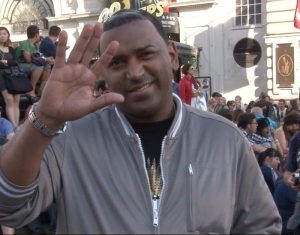
My friend, his music and the man behind the brain tumour story
There is a reason this page has remained almost empty for so many years.
It wasn’t because I had nothing to say about Andrew Reis — better known as Ace Diamond.
It was because I had too much to say.
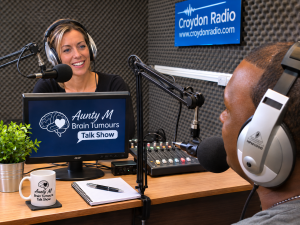
Andrew first came into my life in 2013 as somebody sharing his brain tumour story with Aunty M Brain Tumours Talks Show on Croydon Radio/Podcast.
At the time, I thought I was simply meeting another person from the brain tumour community.
I had no idea I was meeting somebody who would become a truly important friend.
Over the years that followed, Andrew became much more than an interview.
He was talented, kind, humble, funny and incredibly inspiring. He was somebody I cared about deeply, and somebody whose friendship became part of my own story too.
Readers of my book A Brain Tumour’s Travel Tale may recognise him. Andrew is the man I mention in the book.
When Andrew died on 7 February 2017, it broke my heart.
For years I kept coming back to this page, knowing that the video deserved more than simply sitting here on its own.
But every time I tried to write about him, the words wouldn’t come.
I worried that I wouldn’t do him justice.
How do you take somebody who meant so much to you and reduce them to a few paragraphs about a brain tumour?
I couldn’t.
So I left it.
Now, almost ten years after losing him, I finally feel able to tell more of Andrew’s story.
Not only the story of his brain tumours.
But the story of Ace.
Listen To My Interview With Andrew Reis – Ace Diamond
In July 2016, Andrew joined me again on the Aunty M Brain Tumours Talk Show.
By then, he was 38 years old and had already been through an extraordinary amount.
Andrew had faced three brain tumours, alongside repeated operations and treatments.
Yet when you listen to him speak, what stands out is not somebody asking for sympathy.
It is his determination.
His humour.
His love of music.
And his ability to keep looking for hope even when life gave him every reason not to.
Listen to Andrew (Ace) tell his story in full on July 9th 2016, on the Aunty M Brain Tumours Talk Show interview below, or keep reading for the written version
From an Interview in 2013 to a Real Friendship
My friendship with Andrew began in 2013.
Aunty M Brain Tumours was still relatively young, and I was talking to people from around the world about what it really meant to live with a brain tumour.
Andrew was one of those people.
Except it didn’t end when the interview ended.
We stayed in touch.
We talked about brain tumours, of course, because that was something we both understood in our own ways.
But friendship isn’t built only around illness.
I got to know Andrew the person.
The musician.
The friend.
The man with dreams, ambitions and an enormous amount of talent.
And beneath everything he had been through, he remained remarkably humble.
That is one of the things I remember most strongly about him.
Andrew’s Oligodendroglioma Story
Andrew lived with an oligodendroglioma, a type of glioma that develops in the brain.
His brain tumour journey was not straightforward.
By the time of our 2016 interview, Andrew had already faced brain cancer on multiple occasions.
There had been operations.
There had been treatment.
There had been good news followed by frightening news.
And there was always the uncertainty familiar to so many people living with a brain tumour:
What will the next scan show?
Andrew described himself as a three-time brain cancer warrior.
But the word warrior can sometimes hide just how difficult the reality is.
Being strong doesn’t mean never being frightened.
It doesn’t mean treatment doesn’t hurt.
And it doesn’t mean there aren’t moments when everything becomes too much.
Andrew experienced the highs and lows that come with repeated treatment.
But again and again, he found a way to keep moving forward.
Ace Diamond: Music Was Part of Who He Was
Andrew was also Ace Diamond.
A singer, songwriter and hip-hop artist.
Music wasn’t simply something he did after his brain tumour diagnosis.
It was part of who he was.
And throughout everything his health threw at him, music continued to give Andrew a voice.
His creativity allowed him to talk about life, hope and what he had experienced in a completely different way.
It also gave other people the opportunity to see something beyond the words brain cancer patient.
They saw the artist.
That matters to me.
One of the things I have learnt through sharing so many brain tumour stories is how easily the diagnosis can become the headline.
But Andrew was never just his diagnosis.
He was Ace Diamond.
These Three Words
Andrew became involved with a documentary project called These Three Words.
The project followed five people affected by brain cancer and explored something much bigger than medical treatment.
It was about what happens to a person’s life when they hear three words nobody wants to hear:
“You have cancer.”
The documentary explored fear and treatment, but also love, hope and what it means to keep living when your future suddenly feels uncertain.
Andrew was a natural person to be part of it.
Because although he never hid how difficult his journey was, he also had an extraordinary ability to give other people hope.
Meeting the People Behind Brain Tumour Treatment
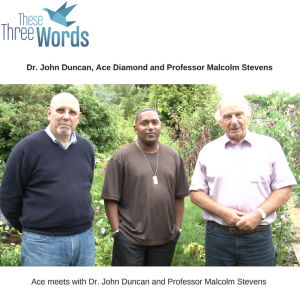
Andrew’s involvement with These Three Words also gave him an opportunity to meet people involved in brain tumour research.
Among them were Professor Malcolm Stevens and Dr John Duncan.
Professor Stevens led research at Aston University connected with the development of temozolomide, a chemotherapy drug that has become an important treatment for some brain tumours.
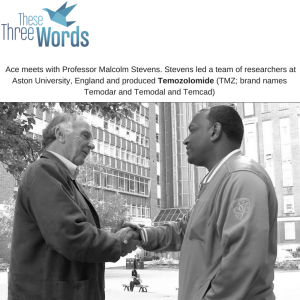
I love these photographs because they bring together different sides of the brain tumour world.
The scientist.
The doctor.
And the person actually living through the disease.
Research isn’t simply something happening inside a laboratory.
At the other end of every experiment, trial and treatment are people like Andrew.
Listen to Andrew (Ace) and Director Paul A. Roselli talk about ‘These Three Words’, a documentary feature that follows five individuals facing brain cancer, finding Hope, Love and Life. This was recorded 7th August 2013, on the Aunty M Brain Tumours Talk Show interview below.
Music also became part of Andrew’s work with These Three Words.
He recorded and performed as Ace Diamond, using his experience and creativity to help bring attention to brain cancer.
One of the projects he worked on was “Grateful.”
“Grateful”
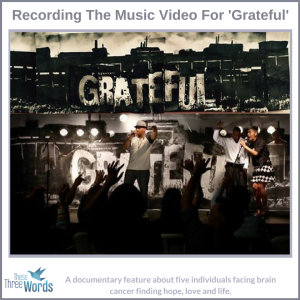
There is something particularly fitting about that title when I think about Andrew now.
Because although I wish desperately that our friendship had lasted much longer, I am incredibly grateful that it happened at all.
The Andrew I Knew
When somebody dies from a brain tumour, it is easy for their final chapter to dominate the story.
I don’t want that to happen here.
Andrew was ill.
Andrew underwent treatment.
Andrew experienced recurrence.
And ultimately brain cancer took him from the people who loved him.
But those facts do not tell you who he was.
The Andrew I knew was kind.
He was humble.
He was talented.
He was incredibly inspiring, although I am not sure he ever fully realised how inspiring other people found him.
And he had a way of making people feel that they mattered.
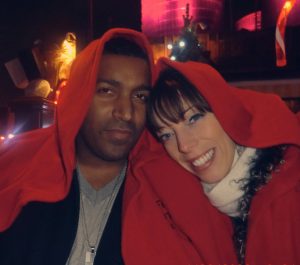
Our Last Interview
Listening back to our 2016 conversation is different for me now.
At the time, it was simply two friends talking about Andrew’s life and what he had survived.
Neither of us knew what was coming.
That is one of the strange things about old recordings.
They capture somebody exactly as they were in that moment.
Their voice.
Their laugh.
Their personality.
Things that photographs alone cannot quite hold.
That makes this interview incredibly precious to me now.
I am grateful that Andrew trusted me with his story.
But I am even more grateful that sharing his story was only the beginning of our friendship.
Losing Ace
Andrew died on 7 February 2017.
Even writing that sentence now is difficult.
There are people you meet through life who become important without you ever planning for it.
Andrew was one of those people for me.
We met because of brain tumours.
Neither of us would have chosen the circumstances that brought our paths together.
But something good came from something neither of us wanted.
Friendship.
When Andrew died, I struggled to write about him.
I knew I should update this page.
I knew his story mattered.
I knew people could learn something from him.
But grief doesn’t always produce beautiful words.
Sometimes it produces no words at all.
And that is what happened to me.
I didn’t leave this page unfinished because Andrew wasn’t important enough.
I left it unfinished because he was too important.
I was frightened that whatever I wrote would never be enough.
The Man in My Book
Andrew’s friendship became important enough that he found his way into my own story.
He is the man I mention in my book, A Brain Tumour’s Travel Tale.
When I wrote about my own life after my brain tumour, it would have felt wrong not to include him.
Because our stories had become connected.
That is another reason I wanted eventually to come back and finish this page properly.
Someone reading my book may see his name.
Someone watching this interview may see a brain tumour patient.
Someone listening to his music may know Ace Diamond.
I knew my friend Andrew.
All of those versions of him deserve to be remembered.
What Is an Oligodendroglioma?
An oligodendroglioma is a rare type of primary brain tumour belonging to the group of tumours known as gliomas.
They occur most often in adults and can cause different symptoms depending on where in the brain the tumour develops.
Symptoms can include seizures, headaches, changes in sensation, weakness and changes involving speech, memory or personality.
Oligodendrogliomas can be grade 2 or grade 3.
Treatment varies from person to person and can include:
- Surgery
- Regular MRI monitoring
- Radiotherapy
- Chemotherapy
- Targeted treatment for some people
The way doctors classify oligodendrogliomas has also changed considerably since Andrew was first diagnosed.
Today, molecular testing plays an important role in confirming an oligodendroglioma diagnosis. Under the current classification, oligodendrogliomas have an IDH mutation and a 1p/19q co-deletion.
That modern terminology should not be retrospectively applied to somebody diagnosed many years ago unless their own pathology has been reviewed.
Most importantly, one person’s oligodendroglioma story cannot predict somebody else’s.
Tumour grade, location, molecular features, treatment and the individual person all matter.
Read More Oligodendroglioma Stories
There are many other people within the Aunty M Brain Tumours community who have shared their experiences of living with an oligodendroglioma.
Read more Oligodendroglioma stories on Aunty M Brain Tumours
Every story is different.
Some people live with their tumour for many years.
Some undergo surgery and monitoring.
Others need radiotherapy, chemotherapy or further treatment when their tumour changes or grows.
Try not to compare your own outcome too closely with another person’s experience.
If You Have Recently Been Diagnosed With an Oligodendroglioma
If you have landed on Andrew’s story after receiving your own oligodendroglioma diagnosis, or because somebody you love has been diagnosed, please know you are not alone.
A diagnosis can suddenly introduce an entirely new language into your life.
Grades.
IDH.
1p/19q.
MRI scans.
Surgery.
Radiotherapy.
Chemotherapy.
It can feel overwhelming.
Give yourself time to understand what your particular diagnosis means.
Andrew’s story belongs to Andrew.
It cannot tell you what will happen to you.
Your medical team can explain your individual tumour, its molecular results and the treatment or monitoring options available to you.
There are also organisations that can provide reliable information and support, including:
The Brain Tumour Charity
Provides information about oligodendrogliomas, treatment and molecular testing, along with support for patients and families.
Brainstrust
Provides practical and emotional support to people living with brain tumours and can help people understand their diagnosis and treatment choices.
Brain Tumour Support
Offers support to patients, families and carers, including one-to-one support and groups.
Brain Tumour Research
Funds research and campaigns for greater investment in brain tumour research.
Remembering Ace Diamond
It has taken me a long time to write this post.
Perhaps longer than it should have.
But grief doesn’t work to a publishing schedule.
I wanted to wait until I could write about Andrew without allowing the way he died to overshadow the way he lived.
Andrew Reis was a brain tumour patient.
But he was also Ace Diamond.
A musician.
A songwriter.
A performer.
A friend.
A man who inspired people.
Someone who remained humble despite everything he had achieved and everything he had survived.
And somebody I will always be grateful that Aunty M Brain Tumours brought into my life.
Andrew died on 7 February 2017.
But his voice is still here.
His music is still here.
His interview is still here.
And the impact he had on the people lucky enough to know him is still here.
Thank you, Ace, for trusting me with your story.
And thank you for becoming my friend.
You were so much more than an interview.
You always will be.

Claire Bullimore is an influential figure in the brain tumour community. She embarked on her brain tumour journey and was diagnosed with an intraventricular meningioma. In response to her experiences, Claire founded ‘Aunty M Brain Tumours,’ a platform dedicated to sharing brain tumour stories. Based in London, England, Claire also identifies as a blogger and speaker for Aunty M Brain Tumours, shedding light on the challenges faced by those diagnosed and amplifying their voices for better awareness and support. Through her dedication and advocacy, Claire’s efforts have been recognized by Brain Tumour Research and other organizations, spotlighting her commitment to making a positive difference for individuals impacted by brain tumours.