
After an unexpected arachnoid cyst diagnosis in July 2019, Mónica Solis underwent two brain surgeries, experienced a cerebrospinal fluid (CSF) leak and spent almost three months in hospital. She shares her experience of diagnosis, complications, rehabilitation and learning to live differently.
For more than 20 years, Mónica Solis had run her own business. She was accustomed to working hard, managing responsibilities and being in control of her life.
But on 31 July 2019, everything changed.
What began with fatigue, neck pain, numbness in her hands and changes to her vision led to an unexpected discovery: an arachnoid cyst near the cerebellum, at the back of her brain.
Within weeks, Mónica underwent her first craniotomy. Unfortunately, complications followed, including a cerebrospinal fluid (CSF) leak, a second operation and an infection that prolonged her hospital stay.
After almost three months in hospital, she needed physiotherapy to help her regain her mobility.
But the physical recovery was only part of her experience.
Mónica also faced depression, overwhelming pain and the emotional challenge of accepting that life would not immediately return to how it had been.
When she shared her story with Aunty M Brain Tumours, she spoke openly about those difficult moments, the support of her mother and what brain surgery had taught her about strength.
This is Mónica’s arachnoid cyst story.
The Symptoms Mónica Initially Ignored
Looking back, Mónica realised that her symptoms had started long before her diagnosis.
At the beginning of 2018, she began experiencing unusual fatigue. Some days, she felt so exhausted that she needed to lie down. She also experienced morning nausea, which she initially thought might be related to weight-loss medication.
Another unsettling symptom was the sensation that her mind was somehow disconnected from her body.
At the time, Mónica continued working and managing her busy life.
Towards the end of June 2019, however, new symptoms appeared.
She began experiencing pain at night, together with numbness in her hands and fingers. Initially, she assumed she had been sleeping awkwardly.
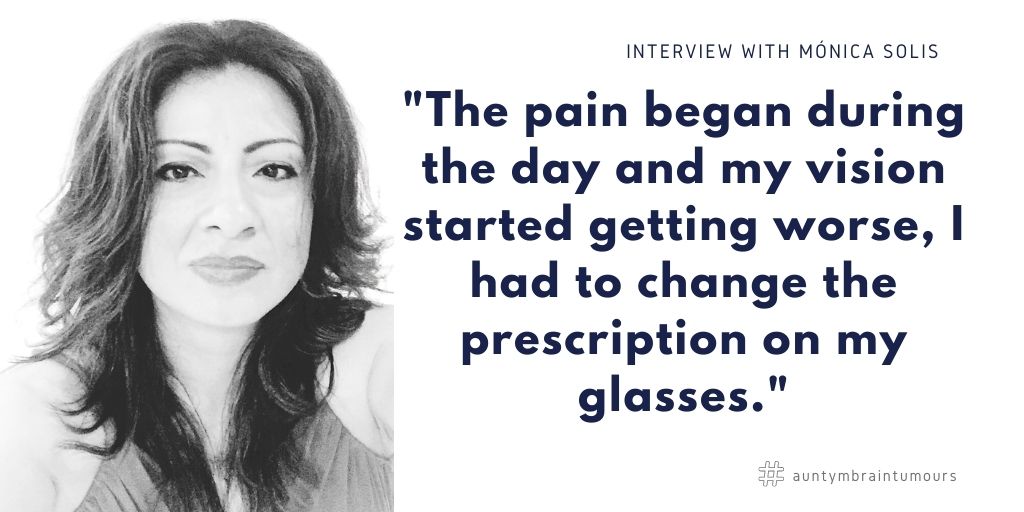
But the pain continued, eventually affecting her during the daytime too.
Her vision also deteriorated, and she needed a new prescription for her glasses.
Concerned about these changes, Mónica decided to seek medical advice.
She had no idea that the investigations would reveal something inside her brain.
An Unexpected Arachnoid Cyst Diagnosis
Mónica attended an orthopaedic appointment because of the pain and numbness she had been experiencing.
Further investigations included X-rays and an MRI scan.
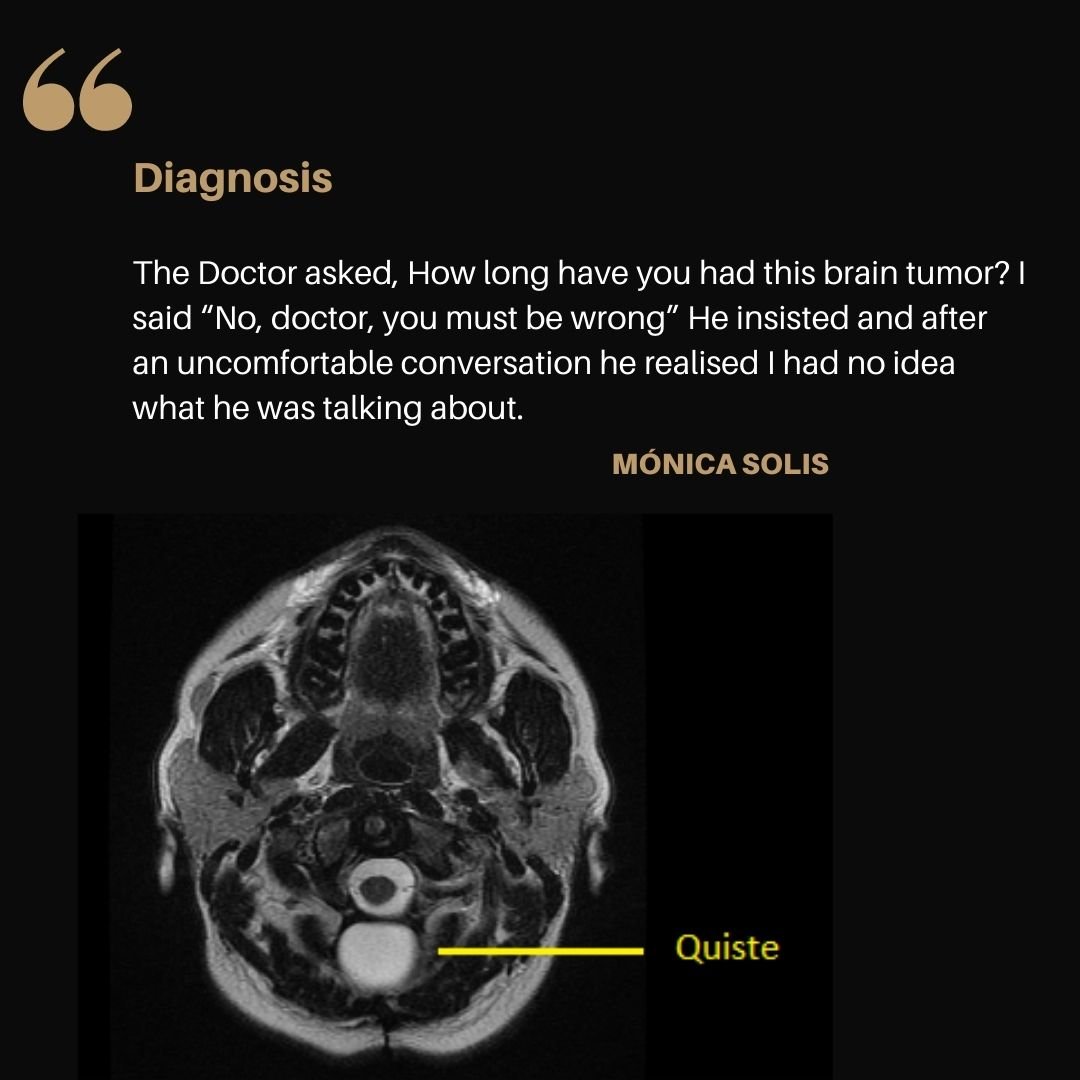
When the doctor examined her results, he noticed an abnormality near her cerebellum, a region of the brain involved in movement and balance.
Then he asked a question Mónica was completely unprepared for.
“How long have you had this brain tumor?”
Mónica was stunned.
She told him he must have made a mistake. The doctor appeared to believe she already knew about the finding.
She didn’t.
Mónica had arrived at the appointment hoping to discover why she was experiencing pain. Instead, she was being told that something had been found inside her head.
Her first thoughts turned to the possibility that she might die.
Further investigations identified the condition as an arachnoid cyst.
Although an arachnoid cyst is not cancerous, some can cause significant problems depending on their size, location and effect on surrounding structures.
For Mónica, surgery was recommended.
Mónica’s First Brain Surgery: 22 August 2019
On 22 August 2019, Mónica underwent a craniotomy, an operation in which a surgeon makes an opening in the skull to access the brain.
During the procedure, the surgical team was unable to remove the entire cyst.
Although the operation was over, Mónica’s recovery would prove far more complicated than she had expected.
Approximately one week later, she noticed fluid leaking from her surgical wound.
This was cerebrospinal fluid, commonly known as CSF, the clear liquid that surrounds and helps protect the brain and spinal cord.
A leak following brain surgery can be a serious complication and requires specialist assessment.
Mónica’s doctors attempted to manage the problem using a lumbar drain, a temporary tube used to drain cerebrospinal fluid.
Unfortunately, the treatment did not resolve the leak.
Mónica was also experiencing enormous pain.
A Second Brain Surgery and Further Complications
On 7 September 2019, just over two weeks after her first operation, Mónica underwent a second brain surgery.
She was already physically exhausted and frightened by everything that had happened.
But further complications followed.
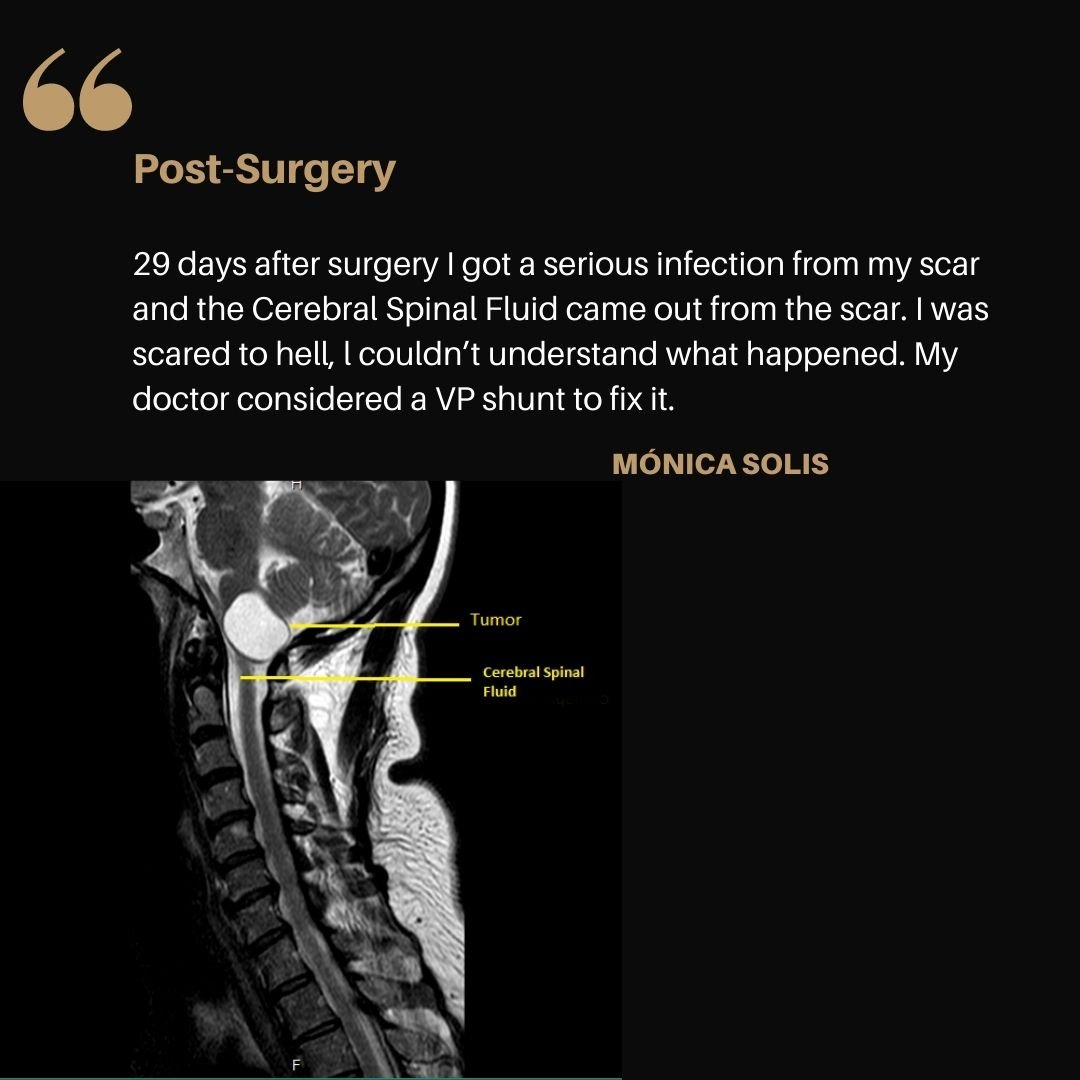
Around 29 days after her second operation, she developed a serious infection involving her surgical wound, along with further CSF leakage.
Her medical team considered another procedure involving a ventriculoperitoneal (VP) shunt, a device used to divert cerebrospinal fluid to another part of the body.
The operation was scheduled for 8 October 2019.
Then, unexpectedly, the fluid leakage appeared to stop.
For more than 48 hours, her dressings remained dry. When her doctor examined her again, there had been no leakage for almost three days.
The planned operation was cancelled.
After weeks of painful treatment and uncertainty, Mónica finally had some encouraging news.
However, her recovery was far from complete.
Further Investigations and a Continuing CSF Fistula
In November 2019, another MRI scan showed that a fistula — an abnormal connection through which fluid can pass — remained.
Mónica described a fluid-filled swelling outside her skull, close to the upper part of her neck.
At a later follow-up appointment, her doctor explained that he did not consider the remaining cyst to be life-threatening and did not recommend another operation.
He encouraged her to return to everyday life.
But after two brain surgeries, an infection and almost three months in hospital, returning to normal was not going to be straightforward.
Almost Three Months in Hospital: Pain, Depression and Recovery
One of the hardest parts of Mónica’s experience was the length of her hospital stay.
She had spent more than 20 years managing her own business and making decisions independently. Suddenly, her days revolved around treatment, medical procedures and waiting for her body to heal.
The lumbar drain was particularly painful.
At her lowest point, the suffering became so overwhelming that she told her doctor she no longer wanted to live.
Following her second operation, Mónica also experienced a severe period of depression.
There were days when she wanted little contact with anyone except her mother and Yuko, someone close to her.
She cried frequently and struggled with sadness, anger and frustration.
For somebody who had always considered herself strong and independent, accepting that she needed help was difficult.
It took months before she began to feel more emotionally stable.
Finding Friendship and Humour on the Hospital Ward
Despite everything, Mónica also remembered moments of kindness and humour.
During her final month in hospital, she became friendly with several nurses.
She learned their shift patterns, talked about their families and enjoyed hearing about their lives outside work.
Those conversations made the long hospital days more bearable.
Some of the nurses even joked that Mónica was treating the hospital like a holiday resort.
When she was finally discharged, several members of staff came to wish her well.
As she made her way towards the lift, some of the nurses applauded.
After almost three months in hospital, Mónica was finally going home.
It was an emotional moment and one she would remember long after leaving the ward.
Learning to Walk Again After Brain Surgery
Leaving hospital was an important milestone, but Mónica still faced a difficult recovery.
She began physiotherapy to rebuild her mobility and improve her balance.
Walking, something she had previously done without thinking, now required concentration and effort.
She continued experiencing dizziness, blurred vision, fatigue and difficulty maintaining her balance.
At times, her surroundings appeared to move, making travelling uncomfortable. She also described involuntary movements of her head.
These symptoms affected her confidence, particularly when she worried about falling.
Mónica continued attending regular medical appointments, including MRI scans approximately every six months and ultrasound examinations of the skull around every two months.
She was grateful to have survived the operations, but she did not pretend that recovery was easy.
Some days were better than others.
And she was discovering that being discharged from hospital did not mean her recovery was over.
The Emotional Impact of Brain Surgery: Learning Patience
Before her diagnosis, Mónica had always been a planner.
She liked being organised, making decisions and knowing what needed to happen next.
Brain surgery changed that.
She could not decide how quickly her wound would heal, prevent every complication or make her body recover through determination alone.
When I asked Mónica about the toughest challenge she had faced, her answer was learning patience.
Instead of planning weeks or months ahead, she began concentrating on smaller goals.
Some days, progress meant attending physiotherapy. Other days, it meant resting and accepting that she needed more time.
The experience also changed how she expressed her emotions.
Before surgery, Mónica had rarely allowed others to see her cry. She associated strength with staying in control.
But after everything she had experienced, she began seeing things differently.
She realised that asking for help, expressing sadness and accepting vulnerability did not make her weak.
Recovery was teaching her a different kind of strength.
Rediscovering the Small Things in Life
One of the most touching parts of Mónica’s story was something she remembered from her hospital stay.
During long afternoons, she would look out of the window and watch the clouds moving across the sky.
She began imagining stories about their shapes, just as she had done when she was a child.
Before her diagnosis, her life had revolved around work, responsibilities and planning ahead.
She could hardly remember the last time she had stopped to appreciate something as simple as clouds or a rainbow.
Yet in hospital, those quiet moments brought her comfort.
After surgery, Mónica began reassessing her priorities.
Family, friendships and everyday experiences became more important than work.
She wanted to spend less time worrying about things she could not control and more time appreciating the life around her.
It was a different outlook from the one she had before her diagnosis.
Why Mónica’s Mother Is Her Personal Hero
When I asked Mónica who her personal hero was, she had no hesitation.
It was her mother.
Their family had already experienced considerable hardship.
Mónica’s brother had died approximately ten years earlier, and her father had been living with a disability for more than twenty years.
Her mother had spent years caring for him.
When Mónica became ill, she faced the frightening possibility of losing her remaining child.
Despite everything, her mum remained a constant source of love and reassurance throughout the hospital treatment.
Mónica remembered how her mother tried to stay positive, even during the most difficult moments.
At times when Mónica felt unable to cope, her mother helped her find the strength to continue.
Her support was one of the most important parts of Mónica’s recovery.
Finding a New Version of Herself After Brain Surgery
As her recovery progressed, Mónica noticed changes that went beyond her physical symptoms.
She felt calmer, more understanding and increasingly empathetic towards other people facing illness or disability.
Connecting with brain tumour survivor communities also helped her.
Reading other people’s experiences gave her encouragement and reminded her that she was not alone.
Learning to Accept Her Surgical Scar
Mónica’s attitude towards her surgical scar also changed.
Rather than trying to hide the area at the back of her head, she chose to keep part of her hair shaved.
For her, the scar represented everything she had survived.
It was a reminder of the operations, complications, difficult days and progress she had made.
Her scar had become part of her story.
She was also learning to accept that life after surgery might look different from the one she had imagined.
Recovering During the COVID-19 Pandemic
When Mónica shared her experience, the world was living with COVID-19 restrictions.
After spending so much time in hospital, she found herself continuing to stay at home.
She rarely went out and was uncomfortable inviting visitors into her home.
The pandemic added another layer of uncertainty to an already difficult recovery.
But Mónica was learning to take life one day at a time, rather than expecting herself to have every answer.
Mónica’s Advice to Anyone Facing an Arachnoid Cyst Diagnosis
One of the most important messages from Mónica’s interview was that people facing a serious diagnosis need understanding, not pressure to remain positive.
When she first told friends about her condition, they naturally wanted to reassure her.
They told her everything would be fine.
Although she appreciated their good intentions, those words could not remove the fear she was experiencing.
Sometimes she needed to cry.
Sometimes she needed to admit she was frightened.
And sometimes she simply needed somebody to listen.
Mónica encouraged people to pay attention to unusual symptoms and seek medical advice when something did not feel right.
She also recognised the importance of receiving emotional support alongside physical treatment.
Her experience showed her that recovery is personal. There is no single way to cope with illness or brain surgery.
What matters is allowing people the space, understanding and support they need.
My Thoughts: More Than an Arachnoid Cyst Diagnosis
What stands out to me about Mónica’s story is how much she experienced in such a short period.
An unexpected diagnosis, two brain operations, painful complications and almost three months in hospital would be difficult for anybody.
But I also think the emotional side of her story deserves just as much attention.
Mónica spoke openly about depression, frustration and the challenge of accepting that she could no longer control everything.
I appreciated that she did not feel the need to make every part of her experience sound positive.
Sometimes, living through a serious neurological condition changes how we see ourselves and the things that matter most.
I especially loved Mónica’s memories of watching the clouds from her hospital bed.
After years of rushing through a busy working life, something so simple became a source of comfort.
And then there was the support of her mother, the friendships she made with the nurses and that wonderful moment when they applauded as she finally left hospital.
Those moments are just as much a part of her story as the operations.
Thank you, Mónica, for sharing your experience with me and the Aunty M Brain Tumours community.
I hope your story helps somebody else facing an arachnoid cyst diagnosis, brain surgery or a difficult recovery feel a little less alone.
What Is an Arachnoid Cyst?
An arachnoid cyst is a usually benign (non-cancerous), fluid-filled sac that forms around the brain or spinal cord.
It develops in association with the arachnoid membrane, one of the protective layers surrounding the central nervous system.
The cyst contains cerebrospinal fluid (CSF), the clear liquid that helps cushion and protect the brain and spinal cord.
Many arachnoid cysts are present from birth, remain stable and never cause symptoms.
However, some can cause problems if they grow large enough to press on surrounding structures or interfere with normal cerebrospinal fluid circulation.
Treatment depends on the cyst’s location, symptoms and individual medical circumstances.
What Symptoms Can an Arachnoid Cyst Cause?
Most arachnoid cysts cause no symptoms.
When symptoms do occur, they may include:
- Headaches
- Dizziness or problems with balance
- Nausea or vomiting
- Visual disturbances
- Seizures
- Other neurological difficulties, depending on the cyst’s location
These symptoms can have many different causes. Finding an arachnoid cyst on a scan does not automatically mean it is responsible for them.
A specialist should assess the symptoms alongside the person’s medical history and scan findings.
Arachnoid Cyst Frequently Asked Questions
Is an Arachnoid Cyst a Brain Tumour?
An arachnoid cyst is not a typical solid brain tumour and is not cancerous.
It is a fluid-filled cyst associated with the membranes surrounding the brain or spinal cord.
However, some arachnoid cysts require specialist neurosurgical care.
Do All Arachnoid Cysts Need Surgery?
No. Most do not require surgery.
Some are discovered accidentally during scans and never cause problems.
Surgery may be considered when a cyst causes significant symptoms, pressure on nearby structures or problems with cerebrospinal fluid circulation.
What Surgery Is Used to Treat an Arachnoid Cyst?
Depending on the individual case, surgeons may use an endoscopic procedure or a craniotomy.
Treatment may involve creating openings in the cyst wall to allow fluid to drain, known as fenestration.
Occasionally, a shunt may be needed to divert fluid.
The surgical team will explain which approach is appropriate and its potential risks.
Can Cerebrospinal Fluid Leak After Brain Surgery?
Yes. A CSF leak is a recognised complication of some neurosurgical procedures.
It may cause clear fluid to escape through a surgical wound or another abnormal opening.
A suspected CSF leak requires prompt medical assessment because it can increase the risk of complications, including infection.
How Long Does Recovery Take After Arachnoid Cyst Surgery?
Recovery varies from person to person.
Some people recover relatively quickly, while others need rehabilitation or experience longer-lasting symptoms.
Recovery depends on the operation, the person’s health and whether complications develop.
Mónica’s experience involved two surgeries and significant postoperative difficulties, so her recovery should not be considered typical of everyone diagnosed with an arachnoid cyst.
Can an Arachnoid Cyst Return After Surgery?
An arachnoid cyst can persist or fill with fluid again after treatment.
The likelihood depends on the procedure and the individual circumstances.
Some patients need follow-up scans, while others may not require long-term imaging.
Your neurosurgical team can explain the appropriate follow-up arrangements.
Arachnoid Cyst Information and Support
If you or somebody you love has been diagnosed with an arachnoid cyst, reliable information can help you understand the condition and prepare questions for your medical team.
Cleveland Clinic — Arachnoid Cysts
Information about symptoms, causes, investigations and treatment.
Read the Cleveland Clinic Arachnoid Cyst Guide
University College London Hospitals NHS Foundation Trust
Guidance about preparing for neurosurgery, recovery and possible postoperative complications.
Read UCLH’s Neurosurgery Recovery Guidance
Brainstrust — Brain Tumour Support
Practical and emotional support for people affected by brain tumours and related conditions.
Connect With Mónica Solis
Mónica has shared more about her experiences through her Brain Time project.
These are the links she provided during her original interview:
Facebook: Mónica’s Brain Time Page
Website: Brain Time
Read More Brain Tumour and Brain Cyst Stories
Every person’s experience of a brain tumour or brain cyst is different.
Some people require monitoring, others need surgery, and recovery can vary considerably.
At Aunty M Brain Tumours, I share personal stories to help people understand what diagnosis, treatment and life afterwards can really involve.
Explore More Brain Tumour Stories
If you have been affected by a brain tumour or brain cyst and would like to share your experience, I would love to hear from you.
Medical disclaimer: Mónica’s story reflects the experience she shared in her original interview, published in January 2021. The medical information is for general awareness and is not a substitute for professional medical advice. Always speak to your specialist healthcare team about your diagnosis, symptoms or treatment.

Claire Bullimore is an influential figure in the brain tumour community. She embarked on her brain tumour journey and was diagnosed with an intraventricular meningioma. In response to her experiences, Claire founded ‘Aunty M Brain Tumours,’ a platform dedicated to sharing brain tumour stories. Based in London, England, Claire also identifies as a blogger and speaker for Aunty M Brain Tumours, shedding light on the challenges faced by those diagnosed and amplifying their voices for better awareness and support. Through her dedication and advocacy, Claire’s efforts have been recognized by Brain Tumour Research and other organizations, spotlighting her commitment to making a positive difference for individuals impacted by brain tumours.

How have you been coping since then? i started to lose my vision as well
Hi, i was recently diagnose with Arachnoid cyst as well. After finding out about arachnoid cyst, i remember i used to have imbalance and fatique and tiredness. Right now after diagnosing, i realize i am more forgetful then usual. Slight anxiousness. May i know how do you cope by after your diagnosis of an arachnoid cyst
Yeah its been 7 years since l went under the surgery and l feel recently l am struggle with the side effects, l get tired and dizzy so easily