Emilia’s Mixed Neural-Glial Brain Tumour Story: Diagnosed at 17 After an Eye Test
After years of severe migraines, Emilia Williamson was diagnosed with a rare mixed neural-glial brain tumour at just 17. Within days, she underwent brain surgery. She went on to graduate from school, become a mother and learn to live with the lasting effects of her diagnosis.
When a Routine Eye Test Changed Everything
For Emilia Williamson, severe headaches had been part of life since childhood.
She began experiencing migraines when she was just eight years old. Because migraines ran in her family, she never imagined there could be another explanation.
But as she grew older, the pain began to change.
Her headaches increasingly affected the area behind her eyes.
During a routine eye appointment in November 2016, Emilia mentioned the migraines to her optometrist.
He examined her optic nerves and became concerned about what he saw.
Rather than assuming the headaches were simply migraines, he contacted her neurologist and recommended an MRI scan.
On 28 November 2016, Emilia attended her first MRI appointment.
She was just 17 years old.
Within hours, her life had changed.
Doctors discovered a mixed neural-glial brain tumour, a rare type of tumour containing both neuronal and glial cells.
Three days later, Emilia underwent brain surgery.
When she shared her experiences with Aunty M Brain Tumours in January 2021, she spoke openly about her diagnosis, the frightening days in hospital, becoming a mother and the lasting effects of brain surgery.
But above all, she wanted to recognise the person who had supported her through everything: her mum.
Years of Migraines Before Her Brain Tumour Diagnosis
Emilia had been dealing with severe migraines for almost ten years before her diagnosis.
Headaches were common in her family, so she had little reason to suspect that something more serious might be happening.
For much of her childhood, they were simply something she learned to live with.
But as Emilia approached adulthood, the headaches began to feel different.
She noticed that the pain was moving behind her eyes.
During an ordinary eye examination, she mentioned this change.
Her eye doctor decided to examine her optic nerves more closely.
He noticed that they appeared slightly compressed.
Initially, he wondered whether Emilia might have a condition involving increased pressure inside the skull rather than a brain tumour.
However, he wanted further investigations to establish what was happening.
He contacted Emilia’s neurologist and arranged an MRI scan.
That decision proved life-changing.
The MRI Scan That Revealed a Brain Tumour
On Monday, 28 November 2016, Emilia attended her MRI appointment at 4.45 pm.
It was her first experience of having an MRI scan.
The examination finished at approximately 6 pm, but something unusual happened afterwards.
The radiologist did not immediately allow Emilia to leave.
Instead, she began asking questions about Emilia’s future, her education and what she planned to do after high school.
At the time, Emilia did not understand why the conversation had taken such a personal turn.
Eventually, she was allowed to return to the room where her mum was waiting.
The moment she saw her mother’s face, she knew something was seriously wrong.
Her mum had already spoken with the neurologist on call, who happened to be someone she worked with.
Emilia had previously said she was comfortable with her mother receiving medical information before her if necessary.
Even so, seeing her mum’s expression told her that the news was not good.
The scan had revealed a brain tumour.
At 17, Emilia was suddenly facing a diagnosis she had never expected.
Being Told She Needed Brain Surgery Immediately
Following the MRI, Emilia was told she had a mixed neural-glial tumour.
The doctors explained that she needed urgent specialist treatment.
That evening, she was given two options.
She could be transferred immediately by ambulance to a children’s hospital in Milwaukee, or she could return home for one final night before travelling the next day.
For Emilia, the decision was clear.
She wanted to sleep in her own bed, see her siblings and spend time with her animals.
These were the ordinary comforts she had always taken for granted.
Now, with brain surgery approaching, they suddenly felt much more important.
Emilia chose to go home.
The following day, she travelled to the children’s hospital.
Her operation was scheduled for three days after her diagnosis.
Why Emilia Could Not Wait Until Graduation
One of Emilia’s greatest concerns was finishing school.
She wanted to wait until she had graduated before undergoing surgery.
But her doctors explained that delaying treatment would be too dangerous.
She was told that she might not survive if she waited.
It was a frightening message for a teenager whose main priorities should have been school, friends and planning the next stage of her life.
Instead, Emilia was preparing for major brain surgery.
Her future suddenly felt uncertain.
But she was determined that her diagnosis would not prevent her from completing her education.
Brain Surgery at Just 17 Years Old
In December 2016, Emilia underwent brain surgery.
She spent approximately two weeks in hospital.
During that time, she experienced an overwhelming number of investigations and medical procedures.
She recalled having at least 18 MRI scans over the two weeks, alongside repeated blood tests and intravenous lines.
It was an exhausting and emotional experience.
There were moments when she felt frightened, overwhelmed and unable to cope with everything happening around her.
Before her diagnosis, Emilia had been a teenager who was used to making her own decisions.
Now she was relying on medical professionals and family members to help her through each day.
The loss of independence was difficult.
And although surgery was necessary, it did not mean that life would immediately return to normal.
Graduating From School After Brain Surgery
Despite everything she had experienced, Emilia remained determined to finish high school.
She was discharged from hospital approximately a week before the Christmas holidays.
Rather than putting her education aside, she used the school break to catch up on the work she had missed.
She completed outstanding homework, tests and quizzes.
It was an extraordinary achievement for someone who had undergone brain surgery only weeks earlier.
On 20 January 2017, Emilia graduated from high school.
Her determination had allowed her to reach an important milestone, even though the weeks leading up to it had been nothing like she originally imagined.
But Emilia’s life was about to change again.
Later that year, she became a mother.
Becoming Pregnant After Brain Surgery
During 2017, Emilia discovered she was pregnant.
She was still recovering from her operation and adjusting to the effects of her brain tumour diagnosis.
Pregnancy brought another significant change to her life.
Unfortunately, she also began experiencing seizures.
Emilia reported having three seizures during her pregnancy.
Her medical team believed they were related to the effects of brain surgery, including scar tissue, alongside the physical demands of pregnancy.
Seizures can sometimes occur following brain surgery, and pregnancy can make seizure management more complicated for some patients.
For Emilia, these episodes were particularly frightening because they occurred while she was preparing to welcome her first child.
The Seizure That Happened in a Museum
One seizure remained especially memorable.
Emilia was visiting a museum in Milwaukee with her family.
They were in the gift shop when she suddenly experienced a seizure.
At the time, she was holding the hand of one of her younger brothers.
Her other brother reacted quickly.
He caught Emilia and helped their mum lower her safely to the ground.
Then he took the younger children away from the gift shop so they would not have to watch their sister having a seizure.
Emilia later reflected on how remarkably calm he had remained.
It was a frightening situation, but her brother’s quick response helped protect both Emilia and the younger children.
For her, it was another example of how much her family had supported her throughout her brain tumour journey.
Welcoming Her Baby Daughter
On 21 November 2017, Emilia gave birth to a baby girl.
Her daughter had originally been due on 1 December.
That date had a particularly special significance.
It would have been exactly one year after Emilia’s brain surgery.
In the space of just twelve months, Emilia had undergone an extraordinary transformation.
She had been diagnosed with a rare brain tumour at 17.
She had undergone urgent surgery, spent two weeks in hospital and completed her education.
She had then experienced seizures during pregnancy.
And now, she was a mother.
Her life had changed in ways she could never have imagined when she attended that routine eye appointment in November 2016.
Although she was grateful to have reached these milestones, living with the long-term effects of brain surgery remained challenging.
The Invisible Effects of Brain Surgery
One of the most important parts of Emilia’s story is her honesty about life after treatment.
When people hear that someone has survived brain surgery, they may assume the hardest part is over.
But Emilia explained that recovery had changed many aspects of her everyday life.
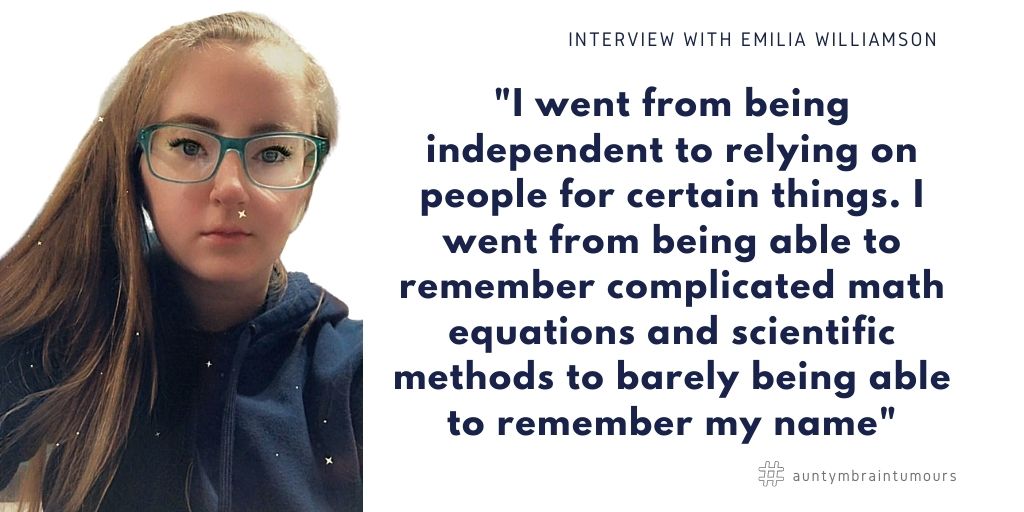
Before surgery, she had been independent and academically confident.
She could remember complicated mathematical equations and scientific information.
Afterwards, her memory and concentration were significantly affected.
Tasks that once came naturally became difficult.
At times, she even struggled to recall basic personal information.
Emilia described the change in her own words:
“My life has changed in many ways. I went from being independent to relying on people for certain things.”
Her experience illustrates something many brain tumour survivors understand.
The lasting effects of treatment are not always visible.
Someone may look physically well while experiencing significant difficulties with memory, language, concentration or fatigue.
For Emilia, these changes affected her sense of independence and confidence.
Living With Speech Difficulties and Memory Loss
When Emilia shared her story in January 2021, it had been approximately four years since her operation.
She was still experiencing several long-term difficulties.
These included:
- Short-term memory problems
- Speech delays
- Difficulty concentrating
- Ongoing severe migraines
- Reduced independence in certain everyday activities
Her migraines continued to affect the area behind her eyes.
However, she reported that investigations had not shown another brain tumour.
That was reassuring, but it did not remove the symptoms she was living with.
For Emilia, recovery had become a long-term process of adapting to abilities that were different from before surgery.
She was grateful to be alive.
At the same time, she was honest about the frustration of dealing with difficulties that remained years after treatment.
Surviving her brain tumour did not mean that everything had returned to the way it was before.
The Emotional Challenges of Brain Tumour Recovery
Emilia also spoke openly about the emotional impact of her diagnosis and hospital treatment.
Spending two weeks in hospital had been particularly difficult.
There were moments when she felt weak, overwhelmed and unmotivated.
She experienced frightening thoughts about death during her admission, something she had not previously been accustomed to.
It was a difficult period that stayed with her.
The combination of a serious diagnosis, loss of independence and constant medical procedures had taken an emotional toll.
Emilia’s honesty is important because young brain tumour patients are often expected to be resilient simply because they are young.
But a teenager facing brain surgery may still experience fear, sadness, frustration and uncertainty.
Emotional recovery deserves attention alongside physical rehabilitation.
For some people, talking therapies, psychological support or connecting with others who have had similar experiences can be an important part of moving forward.
The Mother Who Never Left Emilia’s Side
If there is one person at the centre of Emilia’s story, it is her mum.
Emilia described her as her best friend, greatest supporter and strongest advocate.
Her mother was also a nurse.
During Emilia’s hospital stay, that combination of professional knowledge and parental love became invaluable.
She understood the medical procedures, but she also knew how frightened her daughter was.
When Emilia became distressed about having needles inserted, her mum offered to carry out the procedure herself where appropriate because Emilia trusted her.
When Emilia struggled to listen to the doctors, they sometimes explained information to her mum first.
Her mother would then help Emilia understand what was being said.
It was not simply about medical knowledge.
It was about knowing how to communicate with someone who was frightened, exhausted and overwhelmed.
Two Weeks of Unwavering Support
Emilia’s mother stayed with her in hospital throughout almost the entire two-week admission.
She left for only one day because she needed to take an examination for her own studies.
Otherwise, she remained by Emilia’s side.
When Emilia cried, her mum cried with her.
When Emilia laughed, her mum shared those moments too.
Emilia knew that her mother was also frightened, but she continued providing encouragement and reassurance.
Looking back, Emilia found it difficult to imagine getting through the experience without her.
For anyone supporting a child or young adult through brain surgery, their relationship is a powerful reminder of how important familiar voices and trusted people can be.
Sometimes the most valuable support is simply being there.
The Family, Friends and Community Who Helped
Although Emilia’s mum played a central role in her recovery, many other people helped her family.
Relatives, friends and former colleagues of her father provided practical support and encouragement.
One especially thoughtful gesture came from a former co-worker of her dad.
He arrived at the family’s home with approximately $200 worth of groceries, along with gift cards for a local supermarket.
For a family coping with hospital appointments, treatment and the emotional demands of a brain tumour diagnosis, it was an enormous help.
It meant one less thing to worry about.
Emilia remembered this gesture years later.
She also treasured a gift from her mum: a Destiny toy from Finding Dory.
It was a small, personal present, but one that brought her comfort during a difficult time.
These memories shaped Emilia’s advice about supporting someone who is unwell.
You do not always need to do something elaborate.
Sometimes practical kindness or a thoughtful gift can mean more than you realise.
How Humour and Kindness Helped Emilia
When Emilia was asked about her personal heroes, she mentioned two people who had influenced her outlook on life.
The first was Dr Patch Adams, whose approach to healthcare emphasised kindness, connection and humour.
Emilia had first learned about him in 2014.
She later wrote him a letter and received a personal reply.
She was delighted when he invited her to join a visit to an orphanage in Russia and sent her an autographed book.
For Emilia, his approach to caring for people was inspiring.
She admired the idea that laughter, compassion and human connection could make a difference during illness.
Her second hero was actor Robin Williams, who portrayed Patch Adams in the film of the same name.
She loved his ability to make people smile.
Although she never met him, his work brought her happiness.
After everything Emilia had experienced, she understood how valuable those moments of laughter could be.
Emilia’s Advice for Someone Facing a Brain Tumour Diagnosis
Emilia wanted other people facing difficult diagnoses to know that they did not have to lose hope.
Her own experiences had involved fear, major surgery, seizures and continuing neurological symptoms.
But she had also experienced extraordinary support from family and friends.
Her advice was shaped by both sides of that journey.
Don’t Underestimate Your Strength
Emilia encouraged people to recognise that they may be capable of more than they initially believe.
There were times when she felt unable to cope with everything happening around her.
But with support, she made it through surgery, completed school and adjusted to becoming a mother.
She wanted others to know that asking for help or struggling emotionally does not mean they are weak.
Let People Support You
Emilia’s relationship with her mum showed her the importance of having someone who could advocate for her.
She encouraged people to accept support from trusted family members and friends.
That might involve attending appointments, explaining medical information, helping with everyday tasks or simply listening.
Offer Practical Help to Someone in Hospital
When asked what makes a good gift for someone undergoing treatment, Emilia suggested finding out what they genuinely enjoy.
A favourite toy, comforting object or something to keep them entertained can make hospital life easier.
She also remembered the groceries delivered to her family.
Practical support can make a particularly meaningful difference when families are overwhelmed.
Remember That Recovery Is Different for Everyone
Emilia recognised that brain surgery had changed her life in ways she had not anticipated.
Even years after treatment, she continued living with memory difficulties, speech problems and migraines.
Her experience is a reminder that recovery may take longer than expected and that some effects can be permanent.
People need patience, understanding and appropriate support, rather than pressure to return immediately to their previous abilities.
What Is a Mixed Neural-Glial Brain Tumour?
A mixed neural-glial tumour, also called a mixed neuronal-glial or glioneuronal tumour, belongs to a group of rare brain and spinal cord tumours containing both neuronal cells and glial cells.
Neurons are nerve cells involved in transmitting information, while glial cells support and protect the nervous system.
There are several different types of glioneuronal tumours.
Many are relatively slow-growing, but their behaviour depends on their specific classification, location and individual characteristics.
They can occur in both children and adults, although some types are more commonly diagnosed in younger people.
Are Mixed Neural-Glial Tumours Cancerous?
Many mixed neuronal-glial tumours are low-grade and are not considered malignant.
However, even a slow-growing tumour can cause serious problems if it develops in a sensitive area of the brain.
Its location may affect important neurological functions or interfere with the flow of cerebrospinal fluid.
Treatment decisions depend on the individual diagnosis and whether the tumour can be safely removed.
Emilia described her diagnosis as a mixed neural-glial tumour.
Because her original account does not identify a more specific subtype or tumour grade, it would be inappropriate to assign one without her pathology results.
What Are the Symptoms of a Mixed Neural-Glial Tumour?
Symptoms vary depending on the tumour’s location and effect on surrounding structures.
They may include:
- Persistent or worsening headaches
- Seizures
- Nausea or vomiting
- Changes in vision
- Balance or coordination difficulties
- Memory or concentration problems
- Other neurological symptoms
For Emilia, severe migraines were present for years before her diagnosis.
The change in the location of her headaches, together with the findings during her eye examination, eventually led to an MRI scan.
Her experience highlights why persistent or changing symptoms sometimes require further investigation.
It is important to remember that headaches are common and most are not caused by brain tumours.
How Are Mixed Neural-Glial Tumours Treated?
Treatment depends on the specific tumour subtype, size, location and individual circumstances.
Surgery is often considered when the tumour can be removed safely.
In some cases, complete removal may provide long-term tumour control.
For others, treatment may involve monitoring, further surgery or additional therapies where appropriate.
Patients may also need rehabilitation or ongoing care for symptoms such as seizures, memory problems or speech difficulties.
The specific treatment and follow-up plan should always be discussed with a specialist neuro-oncology team.
Why Emilia’s Story Matters
Emilia’s story began with headaches that had been part of her life since childhood.
Because migraines ran in her family, she never expected anything more serious.
But a routine eye appointment in November 2016 led to an MRI scan and the discovery of a rare brain tumour.
Within three days, she underwent surgery.
At just 17, she found herself facing frightening decisions and an uncertain future.
Despite missing school, she completed her work and graduated only weeks later.
The following year, she experienced seizures during pregnancy before welcoming her daughter in November 2017.
By January 2021, Emilia was still living with speech difficulties, memory loss, concentration problems and migraines.
Yet when she reflected on everything she had experienced, one of the things she most wanted to talk about was her mum.
The person who stayed beside her in hospital.
The person who understood her fears.
The person who helped her communicate with doctors when everything felt overwhelming.
Emilia’s story demonstrates that brain tumour recovery is not just about the surgery itself. It is also about the people who help someone through the difficult days and the support they may continue to need years afterwards.
Her experience also highlights the challenges of being diagnosed during adolescence, when life is supposed to be filled with education, friendships and plans for the future.
For Emilia, those plans changed suddenly.
But she continued moving forward, completing school, becoming a mother and sharing her experiences to help others.
Thank you to Emilia Williamson for sharing her story with Aunty M Brain Tumours.
Her honesty about the lasting effects of brain surgery, the emotional challenges of recovery and the importance of family support will help other people feel understood.
This article reflects Emilia’s experiences as shared in January 2021. It does not represent an update on her current health or family circumstances.
Read More Mixed Neural-Glial Brain Tumour Stories
Mixed neural-glial tumours are rare, and finding other people with a similar diagnosis can sometimes be difficult.
Different types of glioneuronal tumours include ganglioglioma, dysembryoplastic neuroepithelial tumour (DNET) and rosette-forming glioneuronal tumour (RGNT).
Although these are distinct diagnoses, reading other people’s experiences may help you understand some of the challenges associated with rare brain tumours, surgery, seizures and long-term recovery.
You can explore more personal experiences through the Aunty M Brain Tumours survivor stories.
Where to Go After a Mixed Neural-Glial Tumour Diagnosis
If you or someone you care about has been diagnosed with a mixed neuronal-glial tumour, these organisations provide reliable information, practical guidance and emotional support.
The Brain Tumour Charity
https://www.thebraintumourcharity.org/
Provides information about brain tumour diagnosis, treatment, recovery and support for patients and families.
Brainstrust
Offers personalised support for people affected by brain tumours, including help with treatment decisions and living with long-term effects.
Brain Tumour Support
https://www.braintumoursupport.co.uk/
Provides emotional and practical support for people living with brain tumours and their loved ones.
National Brain Tumor Society (USA)
Offers information about brain tumour research, patient support and advocacy.
National Cancer Institute — Mixed Neuronal-Glial Tumour
https://www.cancer.gov/publications/dictionaries/cancer-terms/def/mixed-neuronal-glial-tumor
Explains what mixed neuronal-glial tumours are and how they differ from other brain tumour types.
Your Specialist Medical Team
If you are experiencing ongoing headaches, seizures, memory difficulties or changes to your speech following brain tumour treatment, speak with your medical team about appropriate assessment, follow-up and rehabilitation.
Support may be available through neurology, neuropsychology, speech and language therapy, occupational therapy or other specialist services.
Medical disclaimer: This article shares Emilia’s personal experiences and provides general information for awareness and peer support. It is not intended to replace individual medical advice, diagnosis or treatment from a qualified healthcare professional.

Claire Bullimore is an influential figure in the brain tumour community. She embarked on her brain tumour journey and was diagnosed with an intraventricular meningioma. In response to her experiences, Claire founded ‘Aunty M Brain Tumours,’ a platform dedicated to sharing brain tumour stories. Based in London, England, Claire also identifies as a blogger and speaker for Aunty M Brain Tumours, shedding light on the challenges faced by those diagnosed and amplifying their voices for better awareness and support. Through her dedication and advocacy, Claire’s efforts have been recognized by Brain Tumour Research and other organizations, spotlighting her commitment to making a positive difference for individuals impacted by brain tumours.